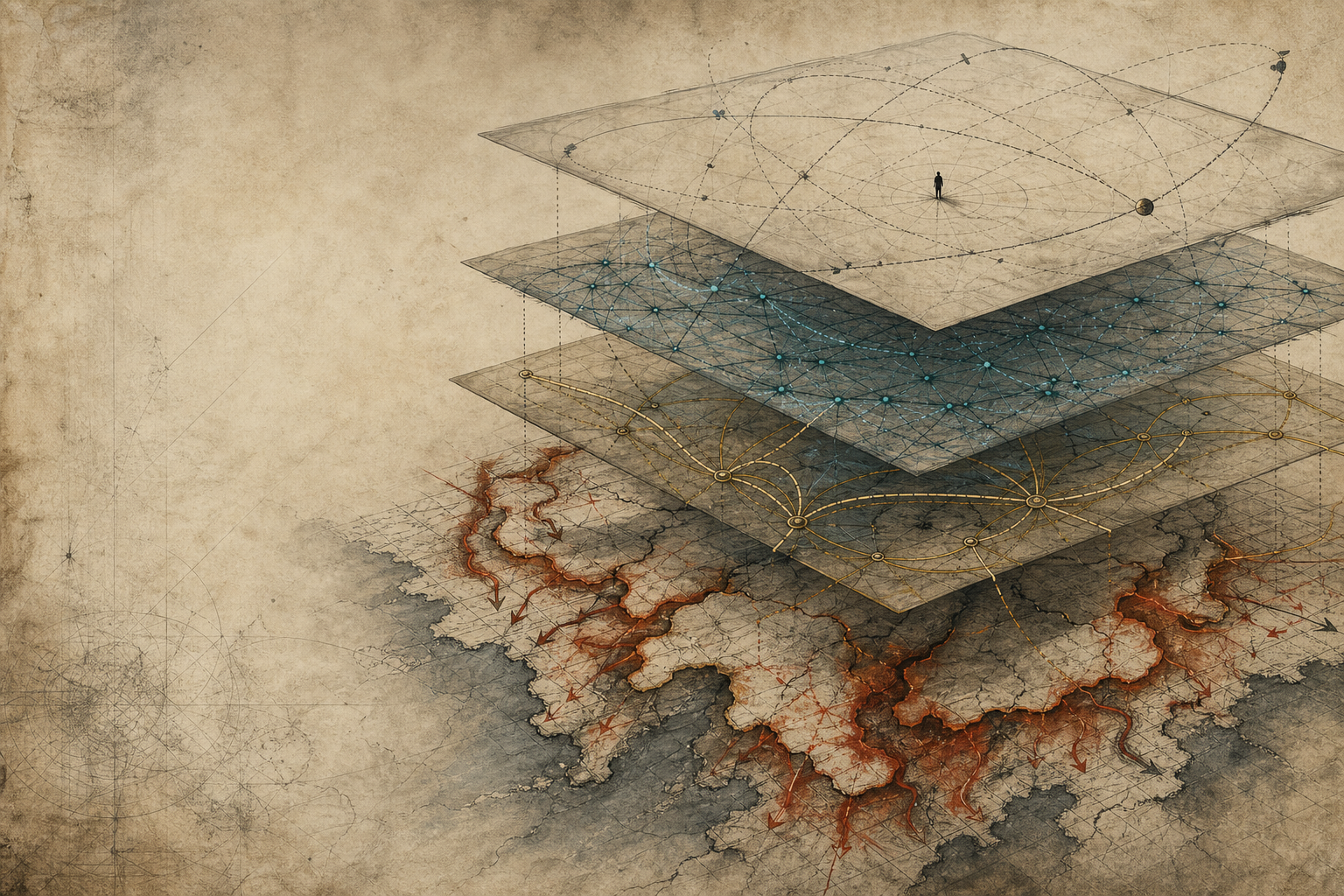
February 2022 was not the death of the old order. It was the funeral everyone finally attended.
The post-Cold War order did not fail as a single event. It suffered progressive structural failure across two decades, with each shock revealing a deeper fracture in security, finance, supply chains, legitimacy, industrial capacity, and shared truth.
9/11 exposed the security model's blindness to non-state, networked violence and made selective rule enforcement visible from outside the Western core.
The financial crisis exposed global financial plumbing as a contagion vector rather than a distributed-resilience machine.
Crimea was the dress rehearsal: territorial aggression met with costs calibrated to preserve normality rather than enforce norms.
Brexit and Trump revealed internal legitimacy collapse inside states expected to underwrite the order.
COVID-19 exposed supply-chain dependency, institutional trust erosion, and the collapse of shared epistemic ground.
Ukraine showed that economic interdependence did not prevent great-power war, and that security guarantees were contingent.
The old order is gone. The question is not whether it will be replaced, but by what, and for whom.
The layers do not cooperate. They tax, tunnel, override, and weaponize each other.
The OSI analogy is useful only if its limit is kept in view. Network layers cooperate to pass packets. Sovereignty layers are adversarial. Lower layers impose jurisdictional drag on upper-layer operations; upper layers can feed pressure downward, but with lag that depends on jurisdictional reach.
Individual capability: AI-assisted competence arbitrage across jurisdictions, markets, and networks.
Protocols, communities, cryptographic enforcement, reputation, and network effects beyond geography.
Supply chains, currency zones, trade agreements, institutional alliances, and market-access pressure.
Territory, borders, courts, police, armies, satellites, infrastructure, and the kinetic veto.
A carrier strike group matters only if logistics, semiconductors, software, finance, alliances, and basing rights still work. Ukraine demonstrated what happens when Layer 1 force is deployed without full-stack competence.
Dollar-denominated stablecoins can extend US monetary influence while enabling transfer outside traditional banking rails. That is neither simple disruption nor simple capture.
Without zero-knowledge and privacy-preserving infrastructure, digital sovereignty remains catalogued, surveilled, and revocable at Layer 1's discretion.
The future is sorted by energy, AI, demographics, legitimacy, information, and climate.
These are not themes. They are constraints and accelerants. They determine which actors can activate sovereignty across the stack, and which actors only appear sovereign until the rails are pulled away.
Aggregate energy demand expands to consume available supply. The question is whether marginal access gets cheap enough for distributed AI before supply chains are captured.
If consumer inference closes the gap, Layer 4 gains. If frontier capability stays gated behind capital, energy, export controls, and cloud APIs, capture wins.
Aging societies lose manpower, fiscal flexibility, and adoption energy. Young societies gain potential and instability simultaneously.
Upper-layer sovereignty needs an operating philosophy. Code, reputation systems, ideology, and techno-libertarianism each fail under scale pressure.
If the information environment is polluted, Layer 4 autonomy becomes confident decision-making on bad inputs. Sensor fidelity is strategic.
Water scarcity, migration, agricultural volatility, and coastal infrastructure exposure reshape Layer 1 legitimacy, Layer 2 supply chains, and Layer 3 physical dependency.
Diffusion, capture, and the managed hybrid are all real at the same time.
The framework's central question is not whether AI transforms governance. It will. The question is whether that transformation distributes power more broadly, concentrates it further, or gives users real tools while keeping the identity, payment, connectivity, and compute rails captured.
AI follows the smartphone trajectory. Good-enough inference gets cheap, open-weight models remain legal, and distributed energy access crosses the useful threshold.
- Local inference hardware below a meaningful consumer threshold.
- Open weights remain within striking distance of frontier.
- Privacy-preserving protocols reach mainstream use.
Frontier capability concentrates in labs, states, and capital-heavy platforms. Regulation, energy cost, and surveillance turn AI into a control multiplier.
- Consumer features move server-side.
- Open weights are restricted above capability thresholds.
- CBDCs and identity rails deploy without meaningful privacy.
The most likely medium-term pattern: tools spread, satisfaction rises, but infrastructure remains surveilled, centralized, KYC-gated, and revocable.
- Open models exist but key features require cloud sync.
- Distribution platforms gate reach.
- Payment and identity rails consolidate.
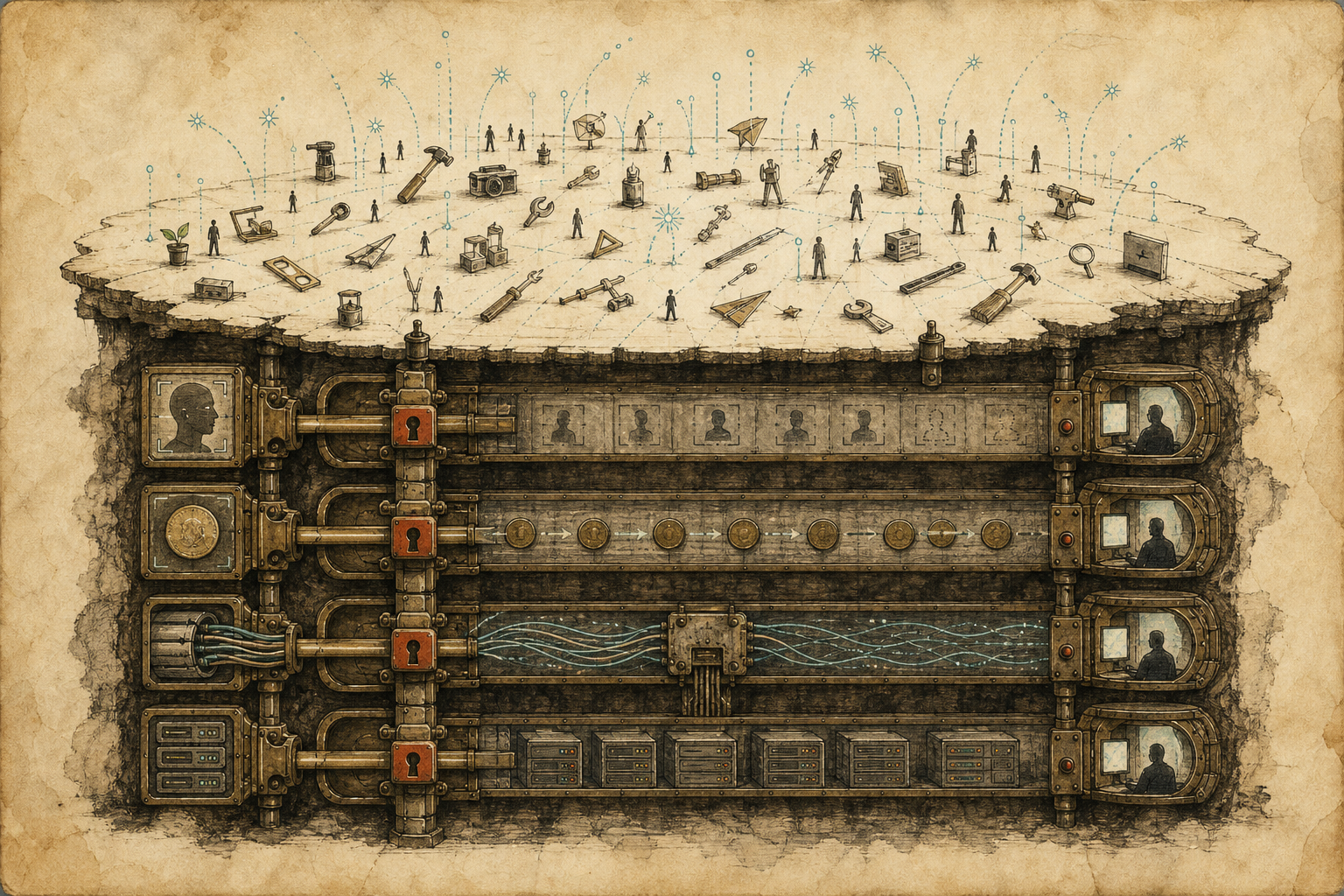
Managed diffusion is the politically sustainable holding pattern because it satisfies the demand for access while preserving the levers of control.
Japan shows why layer interactions, not layers, are the unit of analysis.
Japan is simultaneously high-capability, constitutionally constrained, energy-vulnerable, semiconductor-relevant, demographically pressured, and culturally suggestive. It is not a simple case study. That is why it is useful.
Military sophistication, constitutional constraint.
Layer 1 sovereignty is partially outsourced to the US alliance. That works while the umbrella is credible.
Semiconductor leverage, energy vulnerability.
Japan holds chokepoints in chip equipment and materials while remaining highly import-dependent for energy.
Technical capacity, different social assumptions.
Privacy, obligation, and collective restraint do not map neatly onto Silicon Valley or Chinese governance models.
Possible Logos, unresolved scale.
Wa, long-termism, and disciplined mutual obligation hint at non-libertarian, non-authoritarian upper-layer governance.
The askesis hypothesis.
Layer 4 sovereignty may need to be understood not as a luxury good or lifestyle optimization, but as disciplined practice: carrying more of the burdens lower layers normally absorb. Security, resilience, information filtering, dispute resolution, and public-goods contribution do not vanish just because tools improve. They move onto the individual and the community.
The open problem is enforcement without recreating the state, market-only coordination, or virtue-gated libertarianism. The source note treats this as unresolved. The artifact preserves that uncertainty.
The scenario matrix is not a prediction. It is a map of attractors.
Energy diversification and AI diffusion form the main axes. Demographics, information conditions, climate, and Logos determine whether any quadrant is stable or merely nominal.
Accessible AI plus diversified energy enables meaningful Layer 3/4 sovereignty. Low near-term likelihood because every dependency must resolve in the same direction.
AI tools diffuse, but energy chokepoints let blocs and states extract dependency rents. Individual agency expands unevenly.
Energy diversifies, but AI remains gated. State and bloc competition hardens around industrial policy, export controls, and alliance depth.
AI and energy both concentrate. Sovereignty collapses toward states, megacorps, and capital-intensive infrastructure owners.
The framework is useful only if it can be watched and falsified.
The original note is explicit about claim categories: empirical data, structural inference, and heuristic judgment. This dashboard turns the model into a set of signals rather than a closed ideology.
| # | Metric | What it tests | Cadence | Bias / caveat |
|---|---|---|---|---|
| 1 | China solar supply-chain share | Energy concentration | Annual | Capacity is not the same as usable strategic control. |
| 2 | Frontier vs. open-weight AI gap | Diffusion vs. capture | Quarterly | Benchmark selection affects measurement. |
| 3 | Cost of local good-enough inference | Layer 4 accessibility | Quarterly | Good-enough shifts with expectations. |
| 4 | Server-side vs. on-device AI ratio | Infrastructure capture | Annual | Platforms have incentive to obscure real dependency. |
| 5 | SWIFT vs. CIPS / mBridge fragmentation | Layer 2 bloc formation | Annual | Value and transaction count tell different stories. |
| 6 | Internet censorship index | Layer 3 viability | Annual | Western-observer methodology bias. |
| 7 | Democratic governance trend | Hypothesis B momentum | Annual | Aggregate trend can hide regional reversals. |
| 8 | US LNG share of EU imports | Layer 2 dependency architecture | Quarterly | Contracts and spot markets diverge. |
| 9 | Open-weight legal status | Diffusion viability | Continuous | Regulatory text and enforcement diverge. |
| 10 | AI-enabled surveillance deployment | Capture infrastructure | Annual | Opaque jurisdictions are undercounted. |
| 11 | Energy cost per inference token | Marginal democratization | Quarterly | Model size and task create comparison risk. |
| 12 | TSMC concentration by customer / geography | Semiconductor chokepoint risk | Quarterly | Revenue share is not strategic dependency. |
| 13 | Grid-tied vs. islanded micro-grid ratio | Energy autonomy | Annual | Regulatory definitions vary. |
| 14 | Stablecoin volume vs. payment rails | Layer 2.5 development | Quarterly | Wash trading inflates some on-chain volume. |
| 15 | Narrative velocity detection rate | Information environment | Continuous | Detection capability changes the apparent trend. |
| 16 | Inter-layer capture / diffusion events (the ledger) | Phase of the layer conflict | Continuous (event-driven) | Selection bias toward vivid capture-wins; log diffusion shots and capture failures with equal diligence. |
- Major jurisdictions restrict open weights above capability thresholds.
- Consumer local inference remains expensive while frontier capability accelerates.
- Privacy-preserving protocols fail to reach meaningful adoption.
- Sub-consumer hardware runs professional-grade models.
- Open weights stay near frontier despite pressure.
- Democratic backsliding reverses for multiple years.
- Open tools remain legal but cloud sync becomes mandatory for key features.
- Payment, identity, and connectivity consolidate.
- Users feel empowered while infrastructure dependency remains low-salience.
Structural forces create the landscape. Actors still move through it.
The stack does not move itself. Decisions in governments, firms, alliances, labs, households, and small communities determine which pressures harden into architecture.
States choose whether to use openness as attraction or restriction as protection. Both choices reshape the stack.
Platform decisions about where inference runs and who controls distribution are sovereignty decisions.
Layer 4 does not abolish dependency. It shifts the burden of navigation onto the actor.
In a multi-layer system, the ability to translate between layers is more valuable than dominance within any single layer, unless a new hegemon achieves full-stack dominance.
The war between the layers is now dated, scored, and falsifiable.
Field revisions, June 2026. The framework's central call — that capture would route through export controls and cloud/API gating, with managed diffusion as the medium-term leader — is holding under live data. What follows credits the hits, fixes the misses, and logs the conflict as a running ledger.
The "shot heard round the world" frame is useful for narrative and dangerous for analysis. The layer war did not open with the June 2026 takedown of a commercial frontier model. It opened in 2022 — OFAC sanctioning the Tornado Cash protocol (L1 → L3) and BIS export controls on China's compute (L1 → the AI rail). The forced shutdown of a frontier model is a new phase, not the first shot. The ledger is dated from 2022 deliberately, to resist the recency bias that makes the most vivid event feel like the origin.
Field revisions (v3.0 → v3.1)
Downward feedback lags upward force only across a border the state does not control. Against its own nationals and incorporated firms, Layer 1 runs from directive to compliance in hours — effectively no lag.
Kinetic force is the floor, not the instrument. The operative veto is an export-control directive, a capability notice, a sanctions listing. Layer 1 rarely seizes the artifact; it revokes access to the rail — and spends legitimacy when it does so crudely.
First answer to "who manages the captured rails": not a unitary security-optimizer. A contested apparatus can blacklist, litigate against, depend upon, and regulate the same firm at once — and act on intelligence sourced from that firm's rivals.
Demonstrated frontier capability invites the veto. The more legible a capability — published benchmarks, disclosed cyber reach, advertised utility — the more capturable its owner. Askesis now includes the discipline of not being seen at full capability.
When the artifact is beyond reach — immutable code, distributed weights, an operatorless protocol — Layer 1 captures the human attached to it. Layer 4's deepest conditionality is a body inside a jurisdiction.
When a state demands a partition the architecture cannot cleanly build — block only foreigners, surveil only locals — the rational response is total withdrawal. A narrow demand collapses into broad capability loss for everyone.
The Layer-Conflict Ledger
Each entry is a concrete, dated action by an identifiable actor at one layer, asserting against or escaping another. Op-eds and forecasts do not qualify; actions do. Outcomes are scored per round, not per war — many remain open.
| Date | Event | Vector | Round | What it means |
|---|---|---|---|---|
| Aug 2022 | OFAC sanctions the Tornado Cash protocol | L1 → L3 | split | Opening test of treating autonomous code as a sanctionable entity. Reversed on the code (Dec 2024), won on the person (Aug 2025). |
| Oct 2022 | US semiconductor export controls on China | L1 → AI rail | capture | The template every later AI-rail capture follows. Export control is the state's instrument of choice against the compute layer. |
| Dec 2024 | Van Loon v. Treasury (Fifth Circuit) | L3 → L1 | diffusion | Immutable smart contracts are not "property" under IEEPA. A hard legal ceiling on capturing autonomous code as code; sanctions lifted March 2025. |
| Jan 2025 | DeepSeek open-weight, frontier-adjacent release | capability → L3/L4 | diffusion | If good-enough frontier capability is open and cheap, gating one model does little. The live counterweight to every capture entry. |
| 2024–26 | UK Technical Capability Notice to Apple | L1 → L3/L4 | open | Secret order demanding an encryption backdoor. Apple withdrew Advanced Data Protection for UK users rather than comply — the Partition Trap, plus a live US-vs-UK legitimacy clash. |
| Aug 2025 | Roman Storm conviction (Tornado Cash developer) | L1 → L4 | capture | Convicted of conspiracy to run an unlicensed money-transmitting business (jury deadlocked on the laundering and sanctions counts). When the code is out of reach, the coder is not — the Human Anchor. |
| Jul 2025 | GENIUS Act (US stablecoin framework) | L1/L2 → L2.5 | capture | The escape rail was not suppressed; it was licensed and turned into a dollar-extension instrument. Managed diffusion when the captured side prefers being captured. |
| Jun 2026 | US directive forces Anthropic's Fable 5 / Mythos 5 offline | L1 → frontier AI rail | open | First forced takedown of a commercial frontier model, contested on process grounds. Tests whether capturing one model matters when capability diffuses (Jan 2025). |
A map of the territory, with the uncharted regions marked honestly.
The sovereignty stack names a world where nation-states, blocs, digital networks, and augmented individuals coexist, compete, and constrain each other. The outcome is not predetermined. The variables are visible, measurable, and already in play.
The framework's strongest claim is not prediction. It is legibility: the old order has fractured, the successor will be layered rather than singular, and sovereignty now means practical decision autonomy under pressure across physical, economic, digital, and cognitive control surfaces.
Layer 1 still has the veto, but the veto is latent. Layer 2 can discipline kinetic action through sanctions, supply chains, and institutional thickness. Layer 3 can tunnel but remains exposed to infrastructure capture. Layer 4 can act at institutional scale but is the most conditional sovereignty in the stack.
The deepest unresolved problem is Logos: what makes upper-layer sovereignty legitimate, coherent, and capable of public-goods provision without collapsing into state coercion, market incentive, surveillance, or atomized pirate-cove anarchy.
First data point is in (see the ledger): the manager is not a unitary security-optimizer but a contested, partly rival-capturable apparatus. Still open — one rich event is not yet a pattern.
Africa, Latin America, India, the Gulf, Europe, China, and the US will not inhabit the same quadrant at the same time.
Askesis needs a theory of enforcement, free riders, public goods, and legitimacy beyond disciplined self-selection.
Quantified claims need explicit sources, dates, and confidence levels before the framework becomes a live analytical product.
Metric 16 — the inter-layer conflict ledger — is now live and event-driven. Remaining work: thresholds, owners, and conflict-resolution rules for mixed signals.
Taiwan, AGI discontinuity, water wars, mass migration, cyber-physical collapse, or orbital conflict could reset the model.