About
Infrastructure engineer. AI systems builder. Independent creator.
Systems under pressure — people, machines, and institutions forced to act with incomplete information, conflicting incentives, and consequences that cannot always be replayed.
- 01App Store release
- 03Playable games
- 09Records on Spotify
- 08Published essays
The through-line
I'm John Fite. I build software, AI experiments, strategy games, music, and long-form analytical work. The forms change; the through-line does not.
Professionally, I come from enterprise infrastructure and systems engineering. My current direction is applied AI engineering, with a particular interest in agentic workflows, evaluation, retrieval, secure tool use, observability, and the human controls required to move AI from an impressive demonstration to a system worth trusting.
- Games
- Fog of war, asymmetric information, and decisions under uncertainty.
- Apps
- Disciplined interfaces with everything nonessential stripped away.
- Writing
- First-principles frameworks tested against evidence and adversarial criticism.
- AI work
- A harder question: does the system actually do what the human authorized — or merely something close enough to pass at a glance?
The path here
I served in Marine infantry, spent nearly a decade in Japan as an educator, and later returned to the United States to build a career in technology.
It is not a conventional route, but every chapter trained the same instincts: clarify the objective, understand the environment, reduce ambiguity, build for failure, and keep human judgment where it matters. Those instincts now run through everything in this hub.

From using AI to engineering around it
AI changed the scale of what I could build independently. Using frontier models as coding partners, researchers, critics, adversarial reviewers, and production tools, I have shipped an iOS app, three playable games, original game soundtracks, standalone albums, and a growing catalog of analytical work.
The range is deliberate. This is not a gallery of prompts or a collection of unrelated hobbies. Each project tests whether an idea can be carried from concept through architecture, production, evaluation, and release.
AI multiplies the labor. I retain the direction, judgment, verification, and responsibility. The Lab marks the next phase: building not only with AI, but around it.
- Sentinel
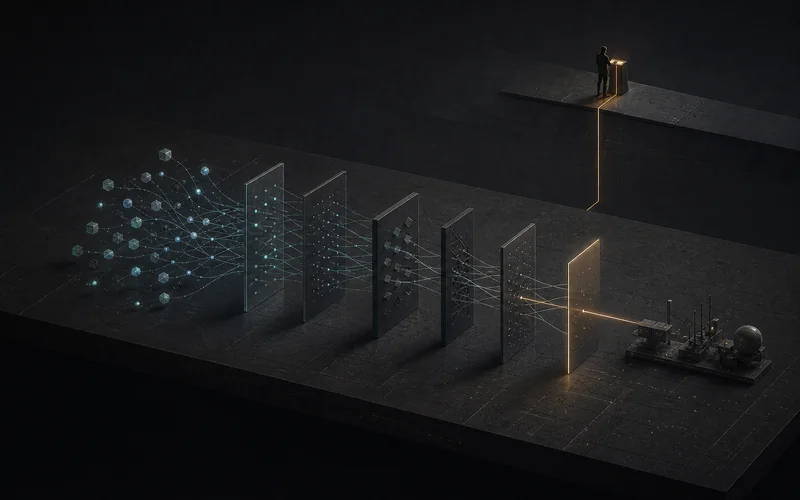
- A public, open-source testnet lab connecting human authorization to one exact blockchain call. Run the local demo, inspect the signed decisions, and follow the tests and adversarial review record.
- Tiny LLM Lab
- First-principles understanding of language models, retrieval, and evaluation through inspectable experiments.
- Project Euclid
- Whether AI-assisted research can preserve a verifiable chain from conjecture to proof.
How I work
- Narrow, inspectable systems over vague platforms.
- Working artifacts over pitch decks.
- Explicit constraints over hopeful prompting.
- Measured failure over confident hand-waving.
- Reusable components over one-off demonstrations.
The standard is simple: build something real, make the assumptions visible, test where it breaks, and leave behind an artifact another person can inspect.
AI helped forge the artifact. I own the blade.
Why this hub exists
This site is the permanent public record of the work: live releases, experiments, essays, soundtracks, and the lessons carried from one project into the next.
Start with the Lab for inspectable AI engineering. Explore Games, Music, Apps, and Writing for the broader catalog.