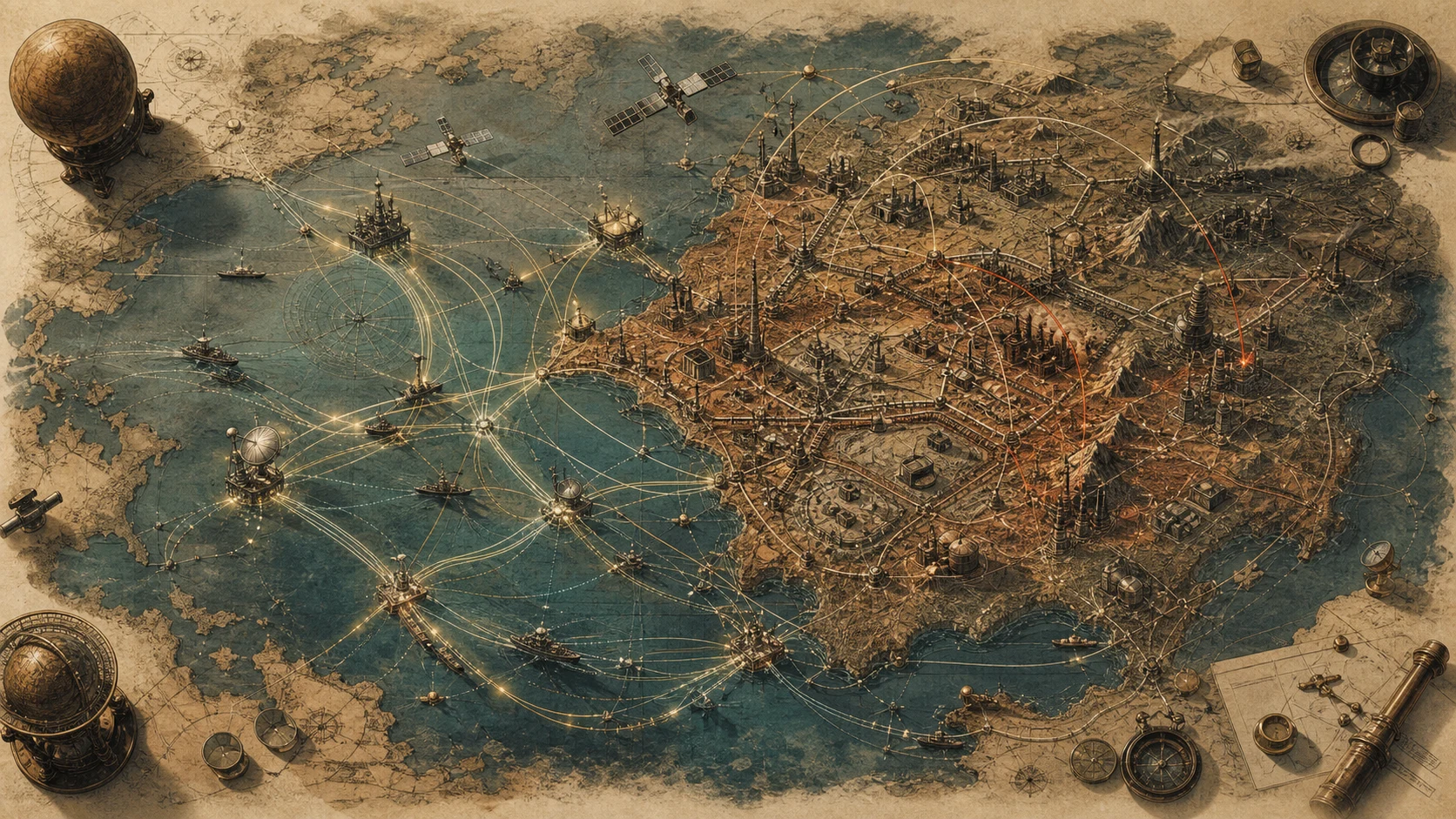
Version note
This is a hardened version of the original “Network Power vs Territorial Power” framework.
The original essay’s core insight remains intact:
Sea power was never just about the sea. It was about controlling the flows that make power usable.
But v1 was too elegant in places. It risked becoming a clean map that quietly explained everything after the fact. This version adds harder edges:
- Network power and territorial power are treated as dimensions, not state identities.
- “Hybrid power” is not an escape hatch.
- Time does not automatically favor the network.
- Both network systems and territorial systems have endogenous brittleness.
- “Territorializing the network” is defined as a mechanism, not a metaphor.
- Historical cases are used as stress tests, not decoration.
- Forecasts must be conditional and falsifiable.
- People inside “nodes” are not terrain.
A good framework reveals structure.
A bad framework becomes a religion.
Do not become a map cultist.
1. Core thesis
The old “sea power vs continental power” dynamic is real, but the labels mislead if taken literally.
The deeper pattern is this:
Network powers gain leverage by controlling flows, optionality, finance, mobility, alliances, standards, logistics, and access. Territorial-production powers gain leverage by controlling land, population, industry, resources, internal lines, proximity, and coercive mass.
Historically, network power often looked like sea power because oceans were the main long-distance flow network.
Today, the same logic includes:
- sea lanes
- air routes
- space systems
- cyber infrastructure
- finance
- insurance
- sanctions
- payment rails
- undersea cables
- cloud platforms
- semiconductors
- AI compute
- logistics software
- software ecosystems
- standards and protocols
- energy routes
- data flows
- skilled labor networks
- alliance access
So the updated frame is not simply:
Sea power vs land power.
It is:
Network optionality vs territorial-production mass.
Or even more compactly:
Flow systems vs mass systems.
Sea power was the original operating system.
Modern technology added modules.
2. Power is not possession; power is usable access
A state may possess oil, food, factories, ships, ports, people, money, minerals, territory, or data.
But possession is not yet power.
Power depends on whether those things can be:
- moved
- converted
- defended
- financed
- supplied
- coordinated
- repaired
- trusted
- replaced
- scaled
- politically sustained
Oil in the ground is not military fuel.
Food in Ukraine is not bread in Berlin.
A chip fab is not AI capability unless design tools, lithography, packaging, power, cloud infrastructure, software, skilled labor, financing, and logistics all connect.
A fleet is not sea control unless it has bases, repair yards, fuel, munitions, surveillance, command systems, political access, and crews willing to operate under threat.
Power is therefore a system property, not merely an inventory count.
A territorial-production power often controls things.
A network power often controls the movement and conversion of things.
That distinction is the heart of the framework.
3. The two axes
The model does not classify states as pure “network powers” or pure “territorial powers.”
That is the first trap.
Most serious powers are mixed. Some are hybrids. Some are network-heavy. Some are mass-heavy. Some are changing category over time.
The model therefore uses two axes:
Figure 01 · Two-axis model
Thin Power
Low optionality, low mass. Vulnerable to pressure, dependence, and local coercion.
Network-Heavy
Controls routes, money, standards, trust, and access, but must keep the maintenance coalition alive.
Mass-Heavy
Controls population, industry, resources, and proximity, but must convert possession into usable pressure.
Hybrid Power
High on both axes. Dangerous when mass learns the network or a network core retains enough mass.
3.1 Network Optionality
Network Optionality is the ability to keep critical flows moving, substituted, financed, defended, legitimized, and coordinated.
A power has high Network Optionality when it can:
- access multiple suppliers
- shift routes under pressure
- finance long contests
- build and maintain coalitions
- control chokepoints
- enforce sanctions or export controls
- dominate standards and protocols
- project military power at distance
- maintain institutional trust
- keep domestic support for system-maintenance costs
- survive the disruption of any single node
Network Optionality is not just “navy.”
A navy is one expression of it.
So are the dollar system, chip export controls, maritime insurance, SWIFT-like payment systems, cloud platforms, satellite constellations, sanctions law, port access, and the willingness of allies to stay aligned when costs rise.
3.2 Territorial-Production Mass
Territorial-Production Mass is the ability to convert land, population, industry, resources, proximity, coercion, and internal control into usable pressure.
A power has high Territorial-Production Mass when it can:
- mobilize population
- command industry
- control resources directly
- use proximity to create local superiority
- absorb punishment through depth
- move forces on internal lines
- coerce neighbors
- build buffers
- impose internal discipline
- substitute mass for finesse
- sustain losses that would break a thinner system
Territorial mass is not just “army.”
An army is one expression of it.
So are industrial basins, rail networks, internal security systems, command authority, resource depth, manufacturing scale, demographic reserves, missile density, and the ability to throw concrete, steel, bodies, and fuel at a problem until it moves.
3.3 Hybrid Power
The most dangerous powers are high on both axes.
Hybrid powers combine:
- territorial depth
- population
- industry
- resources
- protected geography
- military reach
- financial leverage
- technology leadership
- coalition access
- logistics capacity
- internal cohesion
- network control
Examples include:
- Rome after it learned sea power
- Britain at imperial height
- the United States after 1945
- China as an aspiring hybrid power
But “hybrid” must not become a cheat code.
A hybrid is not a magic category used to rescue the model when reality gets messy.
A hybrid is simply a power that scores high on both axes.
4. The recurring strategic pattern
The classic pattern looks like this:
- A territorial-production power rises.
- It dominates nearby land rivals.
- A network power fears a unified regional bloc.
- The network power builds coalitions and restricts flows.
- The territorial power tries to break out.
- It seeks buffers, resources, decisive victory, or immunity from pressure.
- Expansion creates more enemies, longer supply lines, and higher policing costs.
- The network coalition gains time to mobilize.
- The territorial power either wins quickly or is overextended, isolated, strangled, or internally exhausted.
This pattern does not always produce network victory.
Rome beat Carthage.
Russia beat Napoleon and Hitler.
Continental mass can absolutely win.
But the recurring territorial trap is:
The territorial power expands to become secure, but expansion often creates the very encirclement, resistance, and resource strain it was trying to escape.
That is the strategic treadmill.
You conquer the province to secure the border.
Now you need a new border.
Congratulations, emperor. You have unlocked the next logistics nightmare.
Figure 02 · The territorial treadmill
5. The Time Gradient
V1 said time usually favors the side with deeper optionality.
That was directionally useful, but too blunt.
The hardened rule is:
Time favors the side whose cohesion, substitution capacity, replacement rate, and enforcement discipline decay more slowly than the opponent’s shortages, extraction costs, production limits, legitimacy costs, and coalition pressures accumulate.
Time does not inherently favor the network.
Time does not inherently favor territorial mass.
Time favors the better gradient.
Figure 03 · Time gradient
5.1 Network powers weaponize time when they can
Network powers often try to stretch time through:
- blockade
- sanctions
- coalition buildup
- credit
- insurance denial
- export controls
- maritime interdiction
- peripheral attrition
- technology denial
- diplomatic isolation
- supply-chain pressure
The desired effect is not always immediate collapse.
Often the goal is to make the opponent’s system:
- slower
- costlier
- less trusted
- less adaptive
- less replaceable
- less insurable
- less bankable
- less technologically current
Network pressure works best when the target lacks substitutes.
5.2 Territorial powers fear time when shortages compound
Territorial-production powers often fear time because:
- coalitions form
- shortages worsen
- occupied territories resist
- fronts multiply
- logistics stretch
- legitimacy erodes
- replacement rates fall behind losses
- enemies rearm
- internal factions blame each other
This is why Napoleon and Hitler both felt pressure to force decision.
Britain staying in the war meant the continental hegemon could not declare the game won.
The longer Britain survived, the more coalition finance, naval blockade, Russian depth, and eventual American weight mattered.
5.3 But network pressure can leak
The Russia case is the warning label.
A territorial-resource power under network pressure may adapt by recruiting alternative network nodes:
- shadow fleets
- third-country trade
- alternative payment systems
- sanction leakage
- gray-market supply chains
- neutral intermediaries
- sympathetic or opportunistic partners
- overland routes
- import substitution
- wartime repression
- forced austerity
If the network cannot enforce the restriction, the pressure leaks.
If the target can recruit substitute nodes faster than shortages accumulate, time may not favor the network.
The modern network is powerful, but it is not magic.
A blockade with holes is not a blockade.
It is a sieve wearing admiral’s stripes.
6. Network Brittleness
V1 treated network power as flexible and resilient.
That is often true.
It is not always true.
Network power is strong because it is distributed, adaptive, and optional.
Network power is brittle because it depends on trust, legitimacy, coordination, institutional predictability, and human willingness to absorb costs for abstract system benefits.
A network power breaks when the nodes stop believing the network is worth maintaining.
6.1 Domestic consent
Network systems are expensive.
They require bases, fleets, diplomatic commitments, subsidies, tradeoffs, market access, open institutions, immigration flows, technical standards, legal enforcement, and sometimes wars in places most citizens could not find on a map.
The network core must keep asking its people:
“Pay now for optionality later.”
That argument can fail.
Domestic consent erodes when:
- casualties rise
- inequality grows
- allies seem ungrateful
- elites seem corrupt
- system benefits feel abstract
- rivals appear less threatening
- the public wants retrenchment
- the network core feels exploited by its own network
A network power can dominate the world and still lose patience with the job.
Empire does not always fall because barbarians breach the gate.
Sometimes the accountant, the voter, and the exhausted sailor quietly vote to stop paying the maintenance bill.
6.2 Alliance cohesion
Network powers are often coalition managers.
That is a strength.
It is also a vulnerability.
Allies can:
- defect
- free-ride
- hedge
- delay
- demand subsidies
- refuse escalation
- seek side deals
- fear abandonment
- fear entrapment
- disagree over threat perception
Network power requires alignment across many actors with different interests.
The territorial power often only needs one crack.
The network power must keep the whole bridge standing.
6.3 Institutional trust
Network power depends on trusted systems:
- contracts
- courts
- reserves
- insurance
- standards
- payment rails
- alliances
- compliance regimes
- technology licenses
- intelligence sharing
Weaponizing those systems can be effective.
But every use teaches others that the system is a weapon.
That does not mean rivals can instantly replace it. Replacement is hard.
But overuse of network leverage can accelerate the search for alternatives.
Sanctions, export controls, asset freezes, payment exclusion, and insurance denial are not free moves.
They spend trust.
Sometimes spending trust is worth it.
Sometimes the bill arrives later with interest.
6.4 Node and route substitutability
A network is resilient when flows can reroute.
It is brittle when too many flows depend on a small number of nodes.
Examples:
- one key chip fab cluster
- one payment rail
- one canal
- one cloud provider
- one rare-earth processor
- one maritime chokepoint
- one undersea cable route
- one critical software ecosystem
- one dominant insurance market
Network power likes chokepoints when it controls them.
Network power hates chokepoints when it depends on them.
The noose is attached to both necks.
Excellent engineering, gentlemen.
6.5 Rival-network recruitment
This variable matters enough to stand alone.
A network power’s pressure campaign weakens when the target can recruit substitute nodes.
The question is not merely:
“Can the network power impose sanctions?”
The question is:
“Can the target recruit enough alternative flows to make the sanctions survivable?”
Rival-network recruitment includes:
- alternative buyers
- alternative suppliers
- neutral shippers
- gray-market brokers
- non-aligned banks
- shadow fleets
- overland routes
- friendly ports
- alternative insurers
- technology leakage
- permissive jurisdictions
The more rival-network recruitment rises, the less time automatically favors the network power.
6.6 Core legitimacy decay
The hegemon’s domestic legitimacy is not an external variable.
It is part of the network.
If the network core loses faith in the mission, the network degrades even if the ships still float and the cables still carry packets.
Core legitimacy decays when:
- voters see allies as parasites
- elites cannot explain the strategy
- institutions lose credibility
- domestic infrastructure looks neglected
- wars appear optional or endless
- trade feels like deindustrialization
- financial power appears to serve insiders
- national identity no longer supports system maintenance
The network can be strategically brilliant and politically unsellable.
That still counts as brittleness.
7. Territorial Brittleness
V1 emphasized the hunger of territorial power.
V2 makes the internal brittleness explicit.
Territorial-production power is strong because it can command mass.
It is brittle because mass creates weight.
The more territory, people, resources, borders, occupied zones, factions, and security demands a state controls, the more energy it burns just to remain coherent.
Network powers can die of entropy.
Territorial powers can die of gravity.
7.1 Command rigidity
Territorial systems often prize control.
Control can become rigidity.
Rigid command systems suffer when:
- bad news is punished
- subordinates stop improvising
- local knowledge is ignored
- doctrine ossifies
- leader preference overrides reality
- success depends on pleasing the center
- retreat becomes politically impossible
- military decisions become loyalty tests
A territorial power can have vast mass and still misapply it catastrophically.
The map says the army is there.
The radio says the army is still there.
The graves say otherwise.
7.2 Corruption and extraction cost
Territorial power often extracts directly:
- grain
- taxes
- labor
- conscripts
- minerals
- fuel
- tribute
- industrial output
- occupied territory
Extraction can strengthen the center.
It can also rot the system.
The more a regime depends on coercive extraction, the more it may produce:
- corruption
- black markets
- evasion
- sabotage
- hollow reporting
- local resentment
- elite predation
- collapsing morale
Resource wealth can become a brittleness multiplier if it finances perpetual war without forcing institutional adaptation.
You can loot the province.
You cannot always make the province productive.
7.3 Over-centralization
Mass systems often centralize because the center fears fragmentation.
But over-centralization creates blindness.
The ruler cannot see the periphery clearly.
The periphery lies to survive.
The bureaucracy optimizes for pleasing the center.
The center then makes decisions based on curated fiction.
This is how a state can have enormous mass and still repeatedly punch itself in the face.
7.4 Factional militarism
Territorial-production powers can be captured by factions that turn state power toward internal prestige, ideological fantasy, or bureaucratic rivalry.
Factional militarism is especially dangerous when:
- military factions act autonomously
- civilian control is weak
- victory is needed for legitimacy
- humiliation narratives dominate strategy
- resource anxiety becomes panic
- rivals inside the regime compete through escalation
This matters for Imperial Japan.
It matters for any state where the formal strategy says one thing and the internal factional machine does another.
7.5 Demographic drag
Territorial mass depends on people.
People age.
People flee.
People stop having children.
People resist mobilization.
People lose faith.
Demographic drag can reduce:
- military recruitment
- labor supply
- innovation
- fiscal flexibility
- risk tolerance
- care burden capacity
- willingness to absorb casualties
A territorial power may look enormous on the map while its usable human base is shrinking.
Maps do not show age pyramids.
They should.
7.6 Legitimacy dependence on victory
Some regimes require victory to survive.
That is dangerous.
A state dependent on victory may choose a bad war over visible stagnation.
It may escalate because admitting failure is politically lethal.
It may double down because the leadership cannot return home empty-handed.
This creates a brutal pattern:
The regime needs victory to maintain legitimacy, but the pursuit of victory increases the costs that undermine legitimacy.
The territorial treadmill is not only geographic.
It is psychological.
8. Territorializing the Network
“Territorializing the network” means converting flows into controllable dependencies.
It is the attempt by a territorial-production power to make the network less optional and more geographic.
The goal is not simply to build ships or ports.
The goal is to make others’ flows pass through systems the territorial power can influence, price, delay, monitor, deny, or coerce.
8.1 The mechanism
A power territorializes the network by building or controlling:
- ports
- rail corridors
- pipelines
- payment rails
- industrial standards
- logistics platforms
- rare-earth processing
- cloud regions
- undersea cable routes
- satellite services
- chip supply chains
- dominant manufacturing inputs
- shipping capacity
- dual-use commercial infrastructure
- critical market access
- platform ecosystems
- technical standards
- debt, contracts, or concessions with strategic leverage
The point is to turn:
“You can choose among flows”
into:
“Your flow depends on my node.”
That is the stone learning to flow.
Plate · Territorializing the network

8.2 The Continental System as archetype
Napoleon’s Continental System was an early version of this logic.
Unable to defeat Britain at sea, Napoleon tried to reorganize Europe’s trade geography by coercing the continent to deny Britain access.
He tried to turn network flows into territorial control.
The failure mode was instructive.
To police the system, Napoleon had to coerce more states, occupy more territory, punish more defectors, and enforce more rules.
Portugal mattered.
Spain mattered.
Russia mattered.
The attempt to territorialize the trade network produced the very resistance and overextension it was meant to solve.
The enforcement cost exceeded the optionality denied.
This is the key rule:
A territorial power that tries to territorialize flows pays an enforcement and coalition-provocation cost. If that cost rises faster than the control gained, the strategy recreates the encirclement it was designed to escape.
8.3 China’s modern version
China’s strategy is not merely “build navy.”
It is broader:
- build commercial shipbuilding dominance
- develop dual-use maritime infrastructure
- dominate critical manufacturing chains
- increase domestic chip capability
- diversify energy routes
- build pipelines and overland corridors
- expand payment alternatives
- shape standards
- increase rare-earth and battery leverage
- use market access as coercive pressure
- make foreign firms dependent on Chinese production
- make neighbors dependent on Chinese logistics
- make U.S. intervention more costly and uncertain
China does not need to defeat the United States globally.
It needs to make U.S. intervention in China’s near abroad slow, expensive, politically risky, militarily uncertain, and economically painful.
That is territorializing the network.
8.4 The debt-trap guardrail
This concept must not lazily collapse into “debt-trap diplomacy.”
Some claims are sourceable.
Some are contested.
Some are garbage wearing a think-tank tie.
A disciplined version separates three tiers:
Observed Fact
Specific evidence such as:
- loan terms
- port ownership
- collateral rights
- repayment schedules
- control concessions
- standards adoption
- market concentration
- exclusive contracts
- documented restrictions
- supply dependence
- legal enforcement rights
Inference
Reasonable claims such as:
- asymmetric leverage
- lock-in risk
- coercive market access
- dependency effects
- bargaining power shifts
- strategic optionality loss
These require concrete indicators.
Speculation or inadmissible as fact
Unsupported blanket claims such as:
- “All BRI projects are deliberate debt traps.”
- “All distressed debt proves Chinese seizure strategy.”
- “All participation is purely voluntary mutual benefit with no leverage.”
Recipient states have agency.
Local elites have incentives.
Domestic politics matter.
Dependency can be real without turning every borrower into a puppet.
A useful model does not need cartoons.
The cartoons are for television panels and emotionally needy empires.
9. Chokepoints
Chokepoints are where flows become terrain.
Classic chokepoints include:
- Gibraltar
- Suez
- Malta
- Panama
- Singapore
- Hormuz
- Malacca
- Bab el-Mandeb
- Bosporus and Dardanelles
Modern chokepoints include:
- SWIFT-like payment rails
- maritime insurance
- ASML lithography
- TSMC leading-edge fabs
- advanced chip packaging
- cloud regions
- undersea cables
- satellite constellations
- rare-earth refining
- GPU supply chains
- app stores
- operating systems
- AI training compute
- logistics software
- export-control licensing
The principle is the same:
If many flows must pass through a small number of controllable points, those points become strategic terrain.
Plate · Where flows become terrain

But chokepoints are not automatically decisive.
A chokepoint matters according to:
- dependence
- substitutability
- enforcement capacity
- duration of disruption
- stockpiles
- alternative suppliers
- political tolerance
- military escalation risk
- coalition cohesion
- adaptation speed
A chokepoint with no substitutes is a weapon.
A chokepoint with leakage is a tax.
A chokepoint with many substitutes is a nuisance wearing a scary hat.
10. Logistics: where map fantasy dies
Territorial powers often draw arrows.
Network powers often attack the arrow’s fuel, food, rail, credit, ports, repair yards, replacement parts, and political legitimacy.
Conquest expands requirements.
It does not automatically expand usable capacity.
A captured oilfield is not usable fuel unless it can be repaired, staffed, powered, defended, transported, refined, and distributed.
A captured port is not usable maritime power unless ships can dock, unload, refuel, repair, communicate, and survive attack.
A captured chip fab is not usable semiconductor sovereignty unless the entire upstream and downstream chain survives.
This is why Germany’s hunt for oil in World War II kept creating more oil problems.
It needed oil to reach Baku.
Baku was too far away to solve the immediate oil shortage.
The solution required the thing it was trying to obtain.
That is not strategy.
That is a snake eating its own logistics tail.
Figure 04 · Possession is not usable capacity
11. Coalition management
Network powers are often coalition managers.
They do not always need to defeat the territorial power directly.
They need to keep enough enemies, pressures, and constraints in play that the territorial power never fully consolidates.
Pattern:
- Britain funds coalitions against Napoleon.
- Britain sustains resistance to Germany.
- The U.S. turns British survival into Atlantic strategy.
- The U.S. builds NATO and Pacific alliances against the USSR.
- The U.S. today relies on Japan, South Korea, Australia, the Philippines, Taiwan, NATO, India-adjacent balancing, and European tech/finance alignment against China.
The territorial power’s nightmare is not one enemy.
It is a rotating cast of enemies that never fully goes away.
You win the campaign.
Now fight the coalition DLC.
Again.
Forever.
11.1 Alliance as asset and liability
Alliances add:
- bases
- legitimacy
- manpower
- geography
- intelligence
- industry
- economic depth
- diplomatic cover
They also add:
- veto players
- burden-sharing fights
- escalation disagreements
- domestic politics
- incompatible threat perceptions
- fear of abandonment
- fear of entrapment
A coalition is not a single organism.
It is a sack of cats duct-taped to a strategic concept.
Sometimes the cats kill the enemy.
Sometimes they claw through the bag.
12. Historical Gauntlet
This section does not “prove” the framework.
It stress-tests it.
The question is not:
“Can the framework explain the case?”
A clever framework can explain almost anything after the fact.
The harder question is:
“What would make the framework lose?”
Each case below should be read as a test of mechanism, not just a historical illustration.
12.1 Athens vs Sparta
Athens was a maritime-commercial network power.
Sparta was a land-based military power.
Athens relied on walls, fleet, tribute, trade, and imperial maritime connections.
Sparta relied on land armies, discipline, and coalition pressure.
At first, Athens could survive devastation of its countryside as long as its walls and sea routes held.
But Athens did not merely lose because Sparta was “land” and Athens was “sea.”
Athens suffered a compound failure:
- plague
- leadership loss
- internal faction
- allied revolts
- overreach in Sicily
- financial stress
- manpower loss
- eventual Spartan/Persian naval challenge
- grain-route vulnerability
The hardened interpretation:
Athens shows that network power collapses when internal brittleness makes external flow interdiction decisive.
The test is not “internal collapse or external interdiction.”
It is the interaction.
A resilient Athens might have survived external pressure.
A brittle Athens could not.
12.2 Rome vs Carthage
Carthage began as the stronger maritime-commercial power.
Rome began as the stronger territorial manpower power.
Rome’s genius was not that land magically beat sea.
Rome’s genius was that it learned enough sea power while retaining territorial mobilization.
Once Rome became a hybrid, Carthage’s network advantage eroded.
Lesson:
The most dangerous competitor is the territorial power that successfully learns network power without losing its mass base.
This matters for China today.
Not because China is Rome.
Because the conversion pattern is familiar.
12.3 Napoleon and the Continental System
Napoleon dominated the continent but could not defeat Britain at sea.
Britain survived, financed coalitions, controlled maritime flows, and remained a platform for resistance.
Napoleon’s answer was the Continental System: reorganize Europe’s trade geography to deny Britain access.
That was territorializing the network.
It failed because enforcing the system required coercing more territory than France could sustainably manage.
Portugal, Spain, and Russia became enforcement problems.
Enforcement problems became wars.
Wars became overextension.
Overextension revived the coalition.
Lesson:
Territorializing a network can create the very coalition pressure it seeks to escape when enforcement cost rises faster than control gained.
12.4 Dutch Republic
The Dutch Republic was a classic network power:
- trade
- finance
- shipping
- commercial institutions
- maritime reach
But network advantage can decay when rivals build their own network capacity while bringing greater territorial-production mass.
Britain and France had larger population bases, larger fiscal-military potential, and eventually stronger strategic depth.
The Dutch case warns against romanticizing finance and trade as self-defending.
They are not.
A network position must be defended by institutions, military capacity, fiscal resilience, and political cohesion.
Lesson:
Network power can be outscaled if it lacks enough mass to defend the network position.
12.5 Imperial Japan
Imperial Japan is a two-part test.
Japan-A: 1931/1937
In Manchuria and China, Japan still had partial network optionality.
The turn toward territorial mass expansion was not simply forced by immediate material impossibility.
It reflected:
- factional militarism
- army autonomy
- ideology
- prestige politics
- resource anxiety
- legitimacy tied to expansion
- weak civilian control
This tests whether the model can handle irrational or internally factional choices.
States do not always choose the economically optimal path.
Sometimes the fever drives the machine.
Japan-B: 1941
By 1941, the oil embargo compressed Japan’s time gradient.
Flow substitutability narrowed.
Resource anxiety became acute.
The choice for war became catastrophic, but it was no longer the same kind of choice as 1931 or 1937.
Japan’s leaders chose a desperate territorial breakout because the network constraint had become severe.
Lesson:
A network-aspirant may choose territorial mass expansion either from factional fever before necessity, or from compressed time after flow optionality is foreclosed. Do not blur the two.
12.6 Germany
Germany in both world wars was an industrial land power with severe maritime and resource vulnerabilities.
It had:
- strong army
- strong industry
- central position
- tactical and operational excellence
It lacked:
- secure oil
- protected geography
- global finance
- maritime reach
- coalition depth
- durable access to external flows
In World War II, Germany’s problem after France was real:
Britain remained in the war.
The blockade continued.
The United States was moving toward Britain.
The Soviet Union remained a massive eastern factor.
Hitler’s answer was catastrophic:
Invade the Soviet Union without defeating Britain, without securing oil, without adequate logistics, and with an occupation policy that maximized resistance.
Lesson:
A real strategic dilemma can still produce a stupid strategic answer.
The model should explain the dilemma.
It should not excuse the decision.
12.7 U.S. vs USSR
The Cold War was network power against continental empire.
The United States had:
- oceans
- dollar finance
- naval reach
- NATO
- Japan
- global bases
- technology networks
- consumer-industrial dynamism
- alliance legitimacy, at least relative to the USSR
The USSR had:
- land mass
- military depth
- resources
- ideology
- internal coercion
- buffer states
- huge army
- nuclear weapons
The U.S. strategy was containment:
- prevent Soviet consolidation outward
- sustain alliances
- control sea lanes
- compete technologically
- finance pressure
- force the Soviet system to carry its own inefficiencies
The USSR was not defeated by one magic lever.
It was constrained by a network coalition while its own internal burdens compounded.
Lesson:
Network power often wins by preventing decisive expansion and letting the territorial system’s internal costs accumulate.
12.8 Russia 2022–2026
Russia is the live warning against simplistic network triumphalism.
Western network tools imposed real costs:
- sanctions
- financial restrictions
- export controls
- insurance pressure
- technology denial
- diplomatic isolation
- energy-market pressure
But Russia adapted through:
- China trade
- India energy sales
- shadow fleets
- sanctions leakage
- domestic repression
- wartime mobilization
- alternative suppliers
- state-directed substitution
That does not mean sanctions failed entirely.
It means network pressure did not automatically produce decision.
At the same time, Russia’s territorial brittleness also became visible:
- casualties
- corruption
- equipment losses
- command problems
- demographic strain
- inflationary pressure
- manufacturing stress
- dependence on coercion
- legitimacy tied to war outcomes
The Russia case must be held with both hands:
Network pressure leaked because rival-network recruitment worked. Territorial mass endured because coercion and resources bought time. But territorial brittleness accumulated because extraction, casualties, and command rigidity did not disappear.
The model fails if it uses whichever side of this reading is convenient after the fact.
Before analyzing a case, the model must name the dominant variables expected to matter.
No retroactive prophecy.
That is astrology with footnotes.
13. Present case: U.S. vs China
The modern contest is not simply “sea America vs land China.”
It is:
U.S.-led network power versus China-centered territorial-industrial power attempting to become a hybrid network power.
The United States controls much of the high-end connective tissue.
China controls enormous industrial mass.
That is the tension.
13.1 U.S. network advantages
The United States retains major advantages in:
- alliances
- naval reach
- reserve currency
- sanctions capacity
- advanced semiconductor controls
- cloud platforms
- software ecosystems
- military basing
- ISR networks
- blue-water experience
- undersea warfare
- aerospace
- institutional finance
- export-control coordination
- higher-end technology ecosystems
The dollar remains a core U.S. network-power asset.
That is not merely accounting.
It is strategic infrastructure.
But it is also a trust system.
Use it wisely and it compounds leverage.
Overuse it and others slowly search for alternatives.
Slowly does not mean never.
13.2 China’s territorial-industrial advantages
China has major advantages in:
- manufacturing scale
- infrastructure execution
- geographic proximity to Taiwan
- missile density inside the first island chain
- commercial shipbuilding
- drones
- batteries
- rare-earth processing
- civil-military industrial integration
- local escalation dominance near its coast
- internal market size
- production surge capacity
China’s shipbuilding position is especially important.
Shipbuilding is latent maritime power.
Not every commercial shipyard becomes a navy yard.
But industrial capacity, dual-use infrastructure, trained labor, steel throughput, port integration, and maritime production ecosystems matter.
A territorial-industrial power that learns the sea is not merely adding ships.
It is converting mass into network reach.
Rome smiles from the grave.
Carthage does not.
13.3 China’s vulnerabilities
China is powerful, but not invulnerable.
Major vulnerabilities include:
- imported energy dependence
- maritime chokepoints
- food and feed imports
- semiconductor bottlenecks
- dollar and trade exposure
- aging demographics
- coalition encirclement risk
- Taiwan geography
- limited far-seas combat experience
- dependence on stable global demand
- internal legitimacy tied to performance and nationalism
The Malacca dilemma is real, but it must not be caricatured.
The hard version is not:
“Close Malacca and China collapses.”
The hard version is:
“China’s energy and trade system contains maritime chokepoint exposure that becomes strategically dangerous if disruption lasts long enough, substitutes are insufficient, stockpiles draw down, coalition enforcement holds, and escalation remains manageable.”
That is less sexy.
It is also less stupid.
13.4 Taiwan as human node, not terrain
Taiwan is not just an island.
It is simultaneously:
- a geographic barrier
- a political community
- a democratic society
- a semiconductor node
- a military tripwire
- an alliance credibility test
- a first-island-chain anchor
- a global economic chokepoint
- a human-cost multiplier
V1 called Taiwan “Malta, Gibraltar, and a semiconductor fab cluster rolled into one geopolitical heart attack.”
That line stays because it is accurate enough and fun enough to earn its food.
But v2 adds the missing correction:
Taiwan is not merely terrain inside someone else’s strategy. It is a society with agency.
Plate · Human node, not terrain

Taiwanese identity, political preference, willingness to resist, civil-defense capacity, elite cohesion, military readiness, and occupation difficulty all affect the strategic equation.
A fait accompli is not accomplished merely because a map arrow reaches Taipei.
Occupation is not control.
Control is not legitimacy.
Legitimacy is not obedience.
And obedience is not guaranteed when 23 million people have their own vote in the matter, whether Beijing, Washington, or the nearest clever analyst likes it or not.
13.5 What China is trying to do
China’s strategic project is to reduce vulnerability to network-power pressure while increasing its ability to impose local decision.
That means:
- build a blue-water navy
- dominate local A2/AD
- increase domestic chip capability
- diversify energy routes
- build pipelines and overland corridors
- expand alternative payment rails
- strengthen food and energy security
- dominate key manufacturing chains
- expand dual-use maritime infrastructure
- split U.S. alliances
- make Taiwan intervention too costly
- make U.S. escalation politically risky
- build alternatives to Western-controlled systems
- make foreign firms and states dependent on Chinese production
China does not need to defeat the U.S. globally.
It needs to make U.S. intervention in the first island chain slow, costly, uncertain, and politically divisive.
That is the modern territorial-power breakout strategy.
13.6 What the U.S. is trying to do
The U.S. strategy is to preserve network optionality and prevent China from closing East Asia into a Chinese sphere.
That means:
- maintain alliances
- hold the first island chain
- preserve Taiwan’s autonomy or at least prevent forcible annexation
- control semiconductor chokepoints
- keep finance leverage
- maintain naval and undersea dominance
- strengthen Japan, the Philippines, Australia, and South Korea
- encourage India and Vietnam to hedge
- harden space and cyber systems
- diversify supply chains
- preserve credibility without triggering fatalism
- prevent China from controlling critical flows
The U.S. does not need to conquer China.
It needs to prevent China from achieving a decisive regional fait accompli.
That is classic network-power logic.
13.7 The central question
The contest can be summarized as:
Can China convert industrial mass, proximity, and territorialized dependencies into regional dominance before the U.S.-led network converts optionality, alliances, finance, technology, and maritime reach into durable containment?
Or from the U.S. side:
Can the U.S. preserve enough maritime, financial, technological, and alliance control to prevent China from creating a closed regional sphere?
That is the modern version of the old sea-vs-continent struggle.
Same physics.
More domains.
Worse acronyms.
14. Diagnostic Checklist
Use this when analyzing any great-power contest.
14.1 Network Optionality
Ask:
- What flows must keep moving?
- How many substitutes exist?
- Who controls the chokepoints?
- Can routes shift under pressure?
- Can finance continue?
- Can insurance continue?
- Can sanctions be enforced?
- Can technology denial be sustained?
- Can allies absorb costs?
- Can domestic support survive a long contest?
- Can logistics reach the theater under fire?
- Can the network core maintain legitimacy?
14.2 Territorial-Production Mass
Ask:
- What land, population, and industry can be directly mobilized?
- What resources are internally controlled?
- What must be imported?
- How secure are internal lines?
- How much local military superiority exists?
- Can the state coerce neighbors?
- Can it absorb casualties?
- Can it replace equipment?
- Can command adapt?
- Is corruption hollowing the system?
- Does legitimacy depend on victory?
- Are demographics improving or deteriorating?
14.3 Time Gradient
Ask:
- Whose shortages accumulate faster?
- Whose cohesion decays faster?
- Whose replacement rate is stronger?
- Whose coalition improves or fractures over time?
- Whose domestic legitimacy is more fragile?
- Whose flows are more substitutable?
- Whose pressure campaign leaks more?
- Who needs decision sooner?
- Who can survive delay?
Never ask “who benefits from time?” in the abstract.
Ask:
“Which specific variables improve or deteriorate over which time horizon?”
14.4 Territorializing the Network
Ask:
- Is a power converting flows into controllable dependencies?
- Which dependencies are physical?
- Which are institutional?
- Which are technological?
- Which are financial?
- Which are legal?
- Which are political?
- What is the enforcement cost?
- What is the coalition-provocation cost?
- Are recipient states passive, coerced, opportunistic, or actively bargaining?
- Does the strategy reduce vulnerability or create new resistance?
14.5 Human-Cost and Agency
Ask:
- Who lives inside the node?
- What do they want?
- How stable are their preferences?
- How much resistance is plausible?
- What would occupation require?
- What level of coercion would control demand?
- Would the attacker inherit a prize, a ruin, or an insurgent society?
- Are analysts treating people as terrain because the map looks cleaner that way?
If your model has no place for human agency, your model is not strategic.
It is cartographic taxidermy.
15. Evidence Discipline
The framework uses ordinal labels.
It does not pretend to produce fake precision.
No decimal-point cosplay.
No “Network Optionality = 73.4.”
No fake confidence wearing a spreadsheet helmet.
Use:
- High / Medium / Low
- Improving / Stable / Deteriorating
- Substitutable / Bottlenecked / Non-substitutable
- Observed Fact / Inference / Speculation
Figure 05 · Evidence discipline
Observed fact
Documented terms, ownership, schedules, restrictions, concessions, concentration, contracts, or dates.
Inference
A mechanism drawn from concrete indicators: leverage, lock-in risk, substitutability loss, bargaining shift.
Speculation
A claim without enough indicators. Useful as a hypothesis only if it names what would confirm or falsify it.
Every assignment should include:
- the proxy used;
- the source and date;
- the evidence tier;
- the reason it matters;
- the counter-indicator that would flip the assignment.
Example:
“Alliance Cohesion: Medium / Deteriorating. Proxy: public defense-spending disputes, delayed basing agreements, divergent sanctions enforcement. Evidence Tier: Inference. Counter-indicator: renewed multi-year basing commitments plus synchronized export-control enforcement.”
This is not mathematical certainty.
It is discipline.
The goal is not to remove judgment.
The goal is to make judgment inspectable.
16. Model-Loss Rules
The model loses if it can only survive by cheating.
It cheats when it:
- renames the loser after the fact
- calls every hard case “hybrid”
- adds a missing variable only after the outcome is known
- treats “brittleness” as a magic explanation for everything
- refuses to specify time horizon
- refuses to identify dominant variables before analysis
- converts all failed predictions into “still consistent with the model”
- uses vivid language to hide weak mechanism
Before running a case, state:
- expected dominant variable
- expected time gradient
- expected mechanism
- what evidence would confirm it
- what evidence would falsify it
A model that cannot lose cannot teach.
It can only recruit.
That is how frameworks become cults with maps.
17. Forecast Hooks
This framework should not pretend to forecast precise war probabilities.
It is not a crystal ball.
It is an engine for conditional forecasts.
A proper forecast looks like:
If X, Y, and Z variables change in observable ways, then the model expects A pressure to increase, B option to degrade, or C strategy to become less viable by a specified date.
17.1 Example outcome forecast
A Taiwan fait accompli becomes more plausible if several conditions converge:
- U.S. core legitimacy and alliance cohesion deteriorate;
- China’s critical-flow substitutability improves;
- Chinese local military coercion remains high;
- Taiwanese human-cost load is underestimated or degraded;
- financial and blockade tools show high enforcement leakage;
- regional allies hedge instead of mobilizing.
But this must be stated probabilistically and conditionally.
Not:
“China will take Taiwan.”
Rather:
“If at least two major network-deterrence variables degrade while China’s local coercive capacity and flow substitutability improve, the model expects the risk of a successful fait accompli attempt to rise.”
Human agency remains active.
Taiwanese resistance can raise occupation cost.
Allied decisions can change the gradient.
U.S. domestic politics can recover or decay.
Chinese internal politics can accelerate or restrain risk-taking.
The structure pressures.
It does not abolish choice.
17.2 Example leading-indicator forecast
A more useful near-term forecast may not require a war.
By a given audit date, assess whether:
- China’s alternative payment channels increased materially;
- allied export-control enforcement converged or fragmented;
- Taiwan’s civil-defense posture strengthened or weakened;
- U.S. domestic support for alliance defense improved or deteriorated;
- critical supply-chain concentration shifted;
- maritime insurance and sanctions regimes showed high leakage;
- regional states moved toward China, the U.S., or hedging.
This creates a forecast trail before the crisis.
Otherwise the model sits around waiting for catastrophe like a ghoul with a clipboard.
18. Limitations and Normative Hazard
This framework describes pressures.
It does not declare destiny.
Structure matters.
Geography matters.
Flows matter.
Mass matters.
But so do:
- ideology
- leadership
- morale
- doctrine
- intelligence
- luck
- weather
- disease
- personality
- corruption
- accidents
- domestic politics
- technological surprise
- human courage
- human stupidity
Especially human stupidity.
Never underrate the strategic power of some idiot in a room with authority, a bad map, and a deadline.
18.1 The fatalism trap
A clean model can become dangerous.
If leaders believe conflict is structurally inevitable, they may make it so.
If analysts describe Taiwan as a “node” and forget it is a society, they may lower the perceived cost of war.
If strategists treat sanctions, blockades, or export controls as frictionless levers, they may ignore adaptation and blowback.
If territorial powers believe encirclement is inevitable, they may lunge for breakout.
If network powers believe their system always wins with time, they may drift into complacency.
The model should increase clarity.
It should not sedate moral responsibility.
18.2 The agency correction
People are not terrain.
Allies are not chess pieces.
Small states are not just corridors.
Ports are not just dots.
Taiwan is not just a semiconductor node.
Ukraine is not just a buffer.
Sailors, voters, engineers, soldiers, workers, and citizens all affect the system.
Agency is not moral decoration.
It is predictive.
A model that ignores agency will misread resistance, occupation cost, alliance durability, legitimacy, and escalation risk.
That is not ethics floating above strategy.
That is strategy refusing to be stupid.
19. The compact version
Great-power conflict often reduces to a struggle between network optionality and territorial-production mass.
Network powers control flows: trade, finance, sea lanes, alliances, information, technology, logistics, standards, and chokepoints.
Territorial-production powers control mass: land, population, industry, armies, resources, buffers, proximity, coercion, and internal lines.
Network powers usually seek optionality, coalition pressure, flow denial, and time.
Territorial powers usually seek decision, consolidation, resource security, buffer space, and immunity from external pressure.
But time favors neither side automatically.
Time favors the side whose cohesion, substitution capacity, replacement rate, and enforcement discipline decay more slowly than the opponent’s shortages, extraction costs, legitimacy burdens, and coalition pressures accumulate.
The strongest powers are hybrids, but “hybrid” is not an escape hatch; it means high performance on both axes.
The modern contest is no longer just sea vs land. It is sea, air, space, cyber, finance, semiconductors, cloud, AI compute, supply chains, sanctions, standards, and human legitimacy stacked on top of the old geography.
The core dynamic remains:
One side weaponizes connectivity. The other weaponizes proximity and mass. The winner is the side that converts its advantage into usable power without breaking its own system in the process.
20. One-line version
Sea power was never just about the sea; it was about controlling the flows that make power usable.
21. Final warning label
Use this framework like a tool.
Not like a flag.
A good tool makes reality easier to interrogate.
A bad flag makes the tribe feel clever while marching into artillery.
The purpose of the model is not to prove that network powers win, territorial powers lose, China rises, America endures, or history repeats.
The purpose is to ask better questions before reality answers them with explosives.