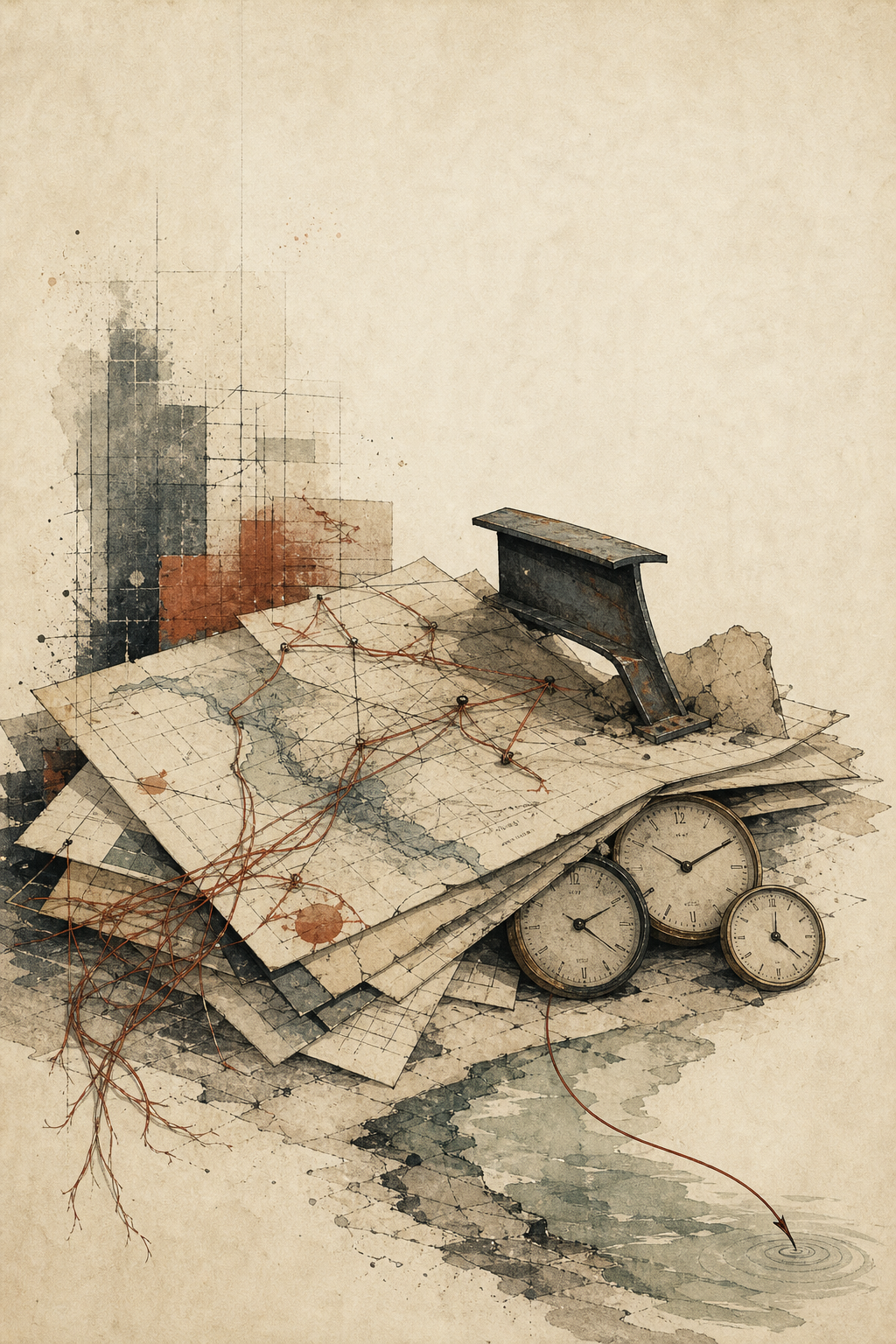
You have probably stood inside a system that was failing while everyone in it was competent, sincere, and working hard.
Maybe it was a team at work. The people were smart. Nobody was lazy. Everybody cared. Yet the situation kept deteriorating, slower, tenser, more confused, and the organizational response was always more.
More meetings to clear up the confusion left by the last meetings. More dashboards to catch what the old ones missed. More rules to close the gaps the previous rules left open. More urgency, more alignment, more accountability, more of everything.
None of it helped.
The harder the system pushed, the worse it got, until people inevitably began looking for someone to blame, because surely a failure this stubborn had to be somebody's fault.
Sometimes it is. A leader lied, a plan was genuinely incompetent, a skill was missing, or a market simply vanished. Not every collapse is mysterious, and not every disaster deserves a systems-theory autopsy. Sometimes the bridge fell down because the bridge was built badly.
But often, the villain you are hunting for is nowhere near big enough to explain the dysfunction you are living through. The effort was real. The intelligence was real. The sincerity was real.
And the collapse happened anyway.
What failed was not effort. What collapsed was contact with reality.
The system was attempting to carry more than it could keep current: more facts, dependencies, risks, exceptions, promises, and feedback loops than its attention and memory could refresh and verify. It was holding more reality than it could stay in honest touch with.
Past that line, working harder does not pull a system back. Working harder is usually what pushed it over.
A drowning system thrashes harder and calls it commitment.
Order TrapCoherence is not order
The thing evaporating in that room was not control. It was not calm, and it was not tidiness.
It was coherence.
Coherence is the working alignment among five core elements:
- Aim: What capacity are we trying to preserve or grow?
- Model: What do we currently believe is happening?
- Memory: What facts, decisions, obligations, and histories must remain available?
- Action: What are we doing because of the model?
- Feedback: What would tell us the model is wrong?
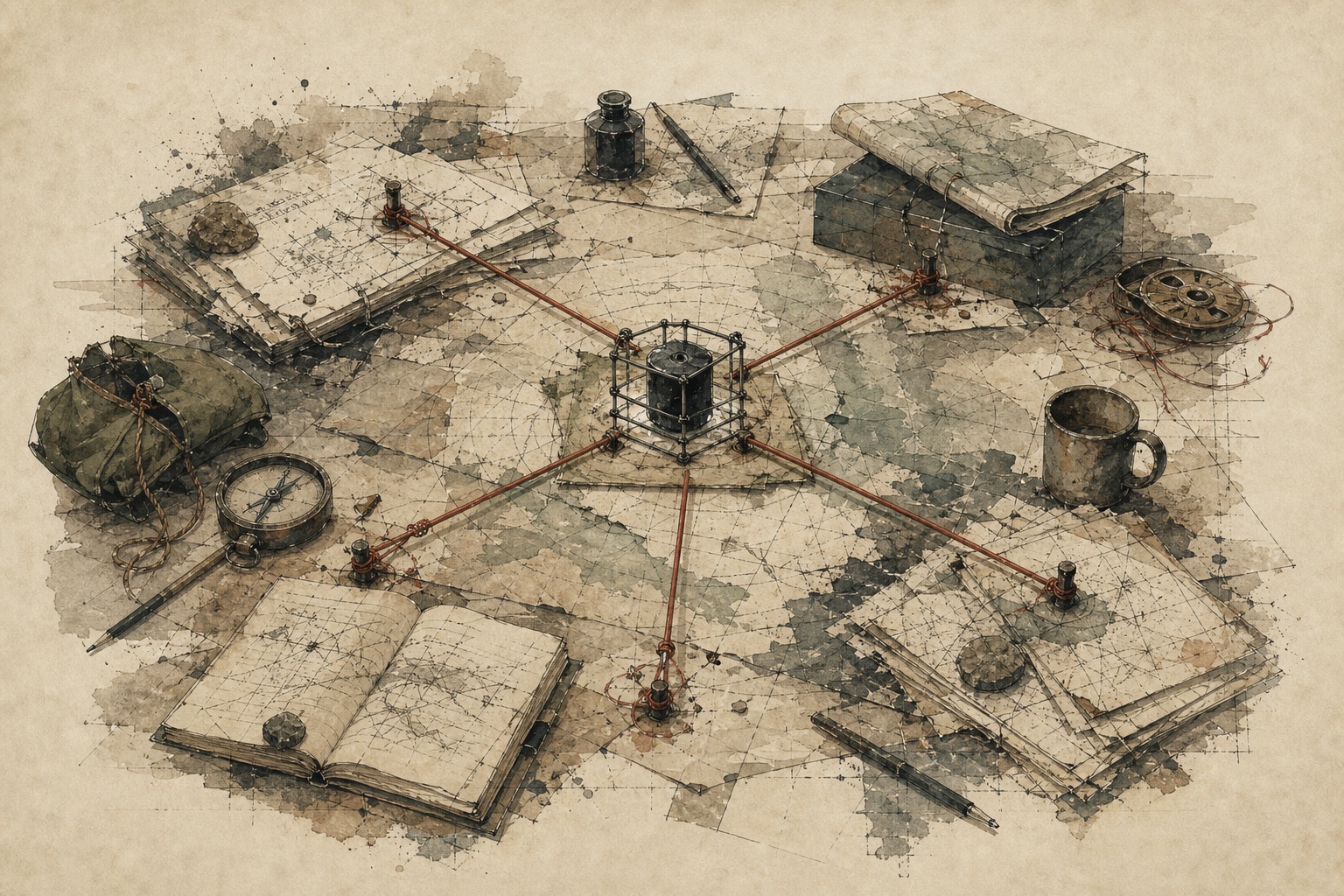
When these five elements stay lined up well enough, a system can keep adapting under pressure even while it looks improvised and loud. When they drift apart, it comes undone no matter how polished it looks.
People mistake coherence for order constantly. To feel the gap, hold two scenes side by side.
Picture an infantry squad taking unexpected contact. To a civilian watching from the outside, it is pure bedlam: yelling, explosions, people throwing themselves into the dirt, smoke, rifle fire, no visible order of any kind. And in that moment, the squad may be one of the most coherent systems on earth. The aim is shared and needs no meeting: survive, find the threat, return fire. The model updates off the most direct feedback imaginable: incoming rounds. The memory lives in the body, drilled until it fires before conscious thought catches up. Action follows the model. Feedback is instant.
It is chaos. It is coherent. Those are not opposites.
Now picture a steering committee running a massive infrastructure migration at a Fortune 500 company. The room is quiet. The slide deck is immaculate. The Gantt chart is a reassuring green. Every risk has an owner, every milestone has a status, and the corporate vocabulary is professional enough to sedate a room.
It is perfectly ordered. And it may be completely blind.
The plan, the committee's model of reality, has come unhooked from the actual state of the work. The engineers closest to the code can see the migration failing, but they have learned not to say so plainly, because truth carries career risk in that room. The dashboard stays green because it has quietly mutated into a political artifact. The picture remains beautiful precisely because reality can no longer reach it.
That system is orderly. It is not coherent.
Messy but coherent
The scene is loud, but aim, model, action, memory, and feedback are updating each other.
Ordered but blind
The room is polished, but the official picture can no longer receive correction.
This is the first trap: when people sense incoherence, their universal instinct is to reach for order. More reporting, more standardization, more governance cadences. Sometimes order genuinely helps; sometimes a checklist saves lives. But just as often, order is camouflage. It makes the system prettier while making it less able to hear the truth.
Order is not the goal. Working alignment is the goal.
Moral BoundaryCoherence is not goodness
Before this framework gets too impressed with itself, there is a second thing coherence is not.
Coherence is not virtue.
A cult can be coherent. A cartel can be coherent. A propaganda machine can be coherent. Aim, model, memory, action, and feedback can align with terrifying efficiency around a rotten purpose. Coherence only tells you whether a system can keep pursuing its aim under pressure. It says nothing about whether that aim deserves to live.
A cleanly functioning machine can still be pointed at hell.
So the first question is never only, "Is this coherent?" It is also, "What is this coherence serving?"
Hidden LoadCoherence debt
When a system carries more than it can keep aligned, the gap between what it is carrying and what it can actually keep current is coherence debt. It is the distance between what a system needs to know to act intelligently, and what it actually, reliably knows.
Like financial debt, it can be useful. Like technical debt, it can be rational. And like all debt, it turns dangerous the moment nobody knows how much of it exists, who owns it, or when the bill comes due.
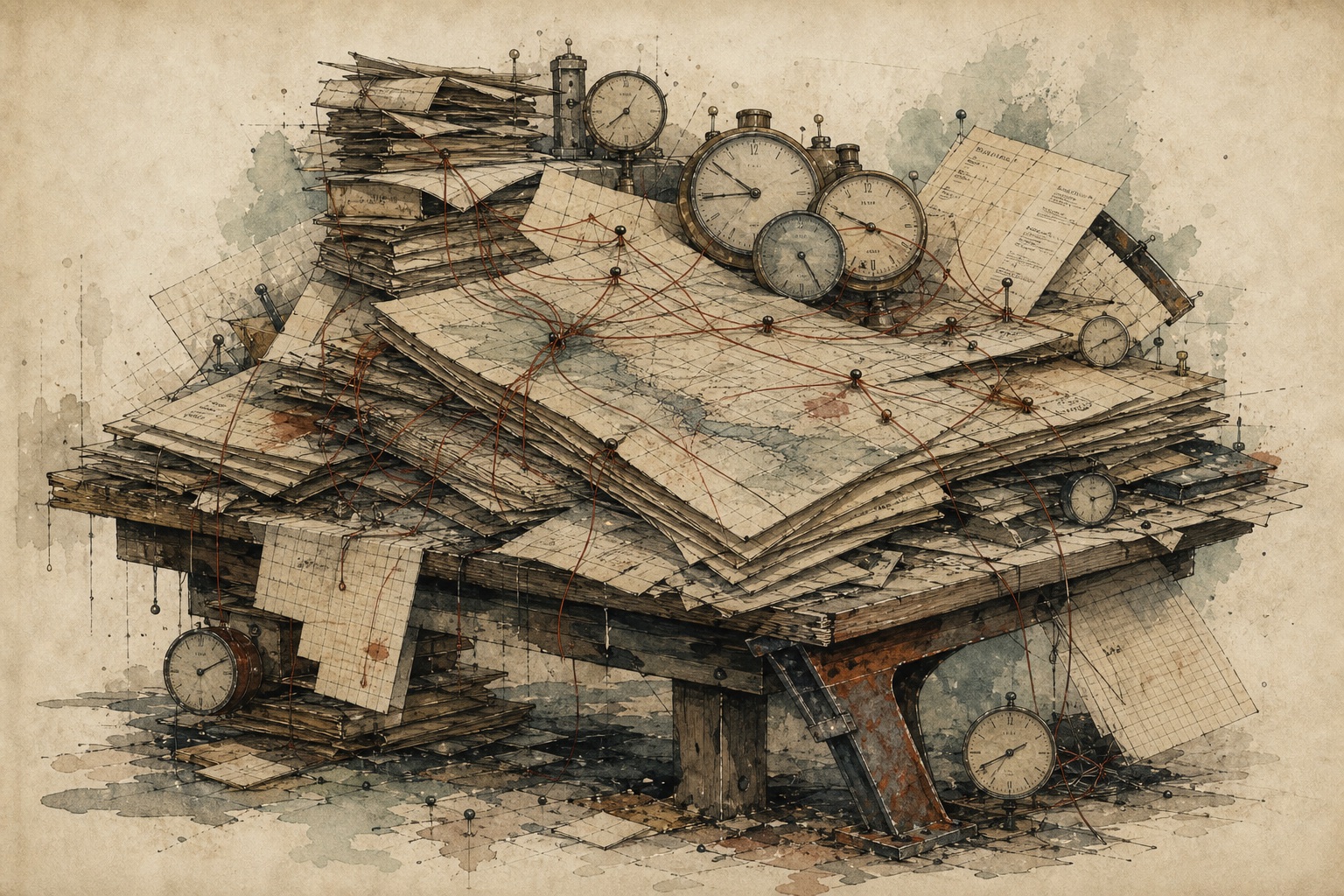
Picture a piece of middleware buried in a corporate network, quietly routing vital data. It was written five years ago. The engineer who built it left three years ago, and the institutional memory walked out the door with him. The service hasn't crashed, so the team assumes it is fine, stacking new applications on top of it and forming new dependencies around it.
The system keeps working, which everyone mistakes for evidence that it is understood. But "it works" is not the same as "we know why it works."
The assumption that it holds is a model, and that model has come unhooked from verification because nobody has looked. The debt isn't a bug in the code. It is the gap between we assume this holds and the unchecked reality of whether it actually does. When the server finally goes down, it will look like the new app broke it. But the new app only delivered the bill; the debt had been accruing in silence for years.
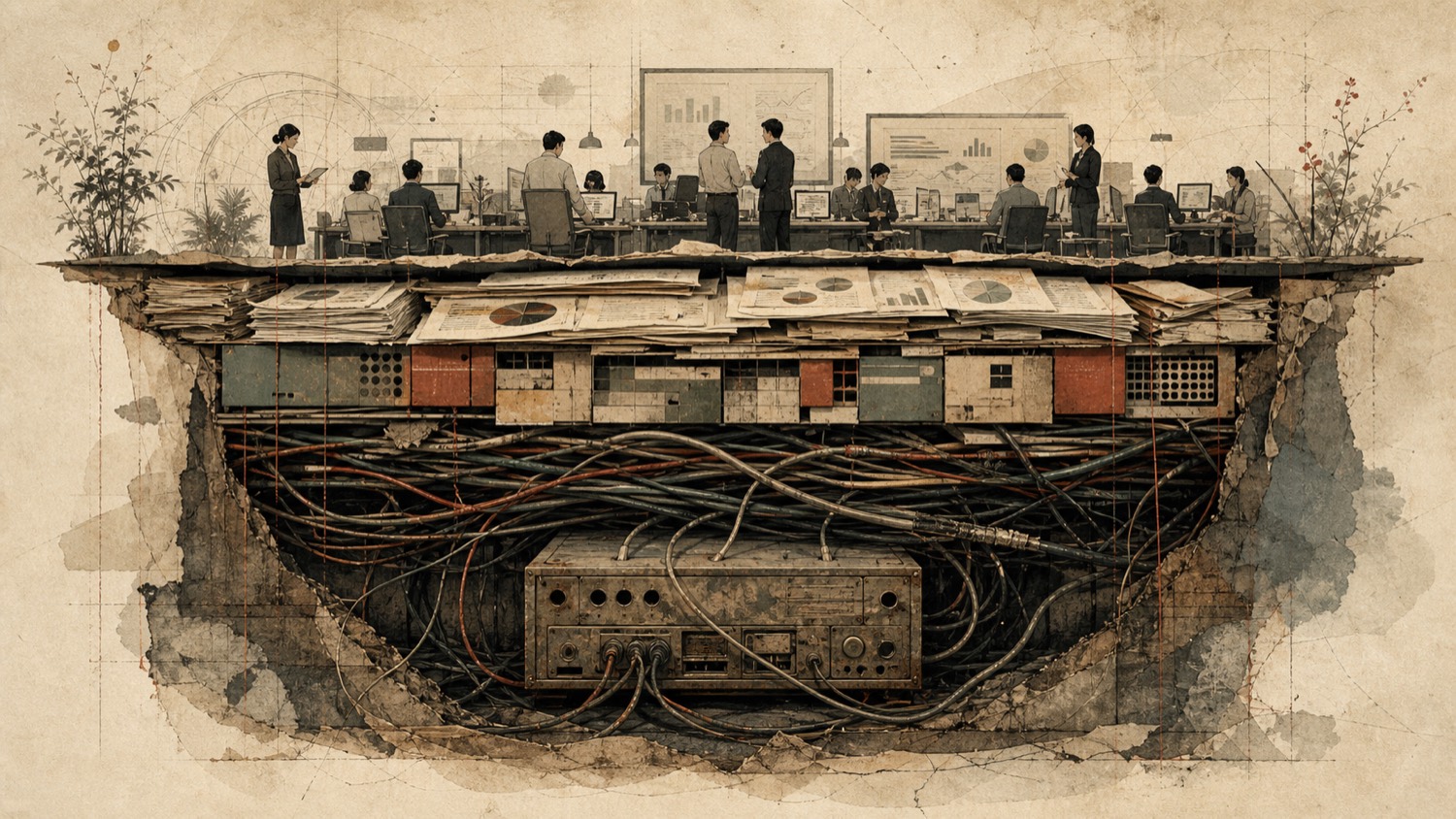
You can feel this debt before you can name it. It shows up as decisions made on information that has quietly gone stale. It shows up as metrics climbing while the reality they were invented to measure rots underneath. It shows up as exceptions piling up until they become the real process, while the official process stays pure and useless. It shows up in the body before it ever hits a dashboard: the creeping dread before a meeting, the private side-channels where the real conversation happens, the institutional smell of wet carpet and suppressed screaming.
Some debt is normal, and some is necessary. A startup, a campaign, or a family with a newborn takes on more than it can fully track because standing still would be worse. Going into debt is sometimes the cost of motion.
The danger is not debt. The danger is debt that becomes hidden ("we don't talk about that here"), moralized ("questioning the timeline means you're not committed"), or turned into identity ("this is just who we are"). That is when it stops being a temporary cost of movement and starts governing the system from underneath.
The test is not whether you have inconsistencies, every living system does. The test is whether you can still detect the inconsistency, name it out loud without ritual sacrifice, and correct it before it starts running you.
Load TaxonomyThe kinds of load
Load is an easy word to say and a useless one if it means everything. A system can be buried in several different ways, and each requires a different shovel:
Epistemic load is too much to know, verify, or keep current. The map is out of date, and nobody is sure which parts are still true.
Coordination load is too many handoffs, approvals, and cross-functional ceremonies. Everyone is involved, and no one is responsible. Work spends more time being synchronized than done.
Memory load is too many decisions, unwritten promises, and "temporary" workarounds to hold. The system forgets why it chose things and mistakes its own forgotten compromises for reality.
Signal load is dashboards and alerts multiplying until the problem is no longer a lack of data, but the impossibility of telling which data deserves belief.
Political load is too much danger attached to saying what is true. People stop reporting reality, and the official picture brightens as the actual one rots.
Identity load is too much self-image fused to the current plan, role, or metric. Feedback stops being information and becomes an attack.
These travel together, but they are distinct. A team drowning in coordination load needs clearer ownership. A team drowning in political load needs protection for truth-tellers.
Treating all of these with the universal corporate medicine of "try harder" is like prescribing push-ups for smoke inhalation. The load has to be named before it can be reduced.
Pressure FieldThe basic pattern
Underneath all of it, the pattern is simple. Coherence weakens when load and volatility outrun refresh rate and source fidelity.
- Load: How much the system is trying to carry.
- Volatility: How fast and violently reality is changing.
- Refresh rate: How often the system updates its picture.
- Source fidelity: How much that picture can be trusted.
The visual imbalance is intentionally qualitative. The moment the instrument becomes a target number, it starts manufacturing the debt it was meant to reveal.
Too much to track, changing too fast, updated too slowly, through signals too filtered to believe: that is the recipe, and it is almost always closer to the real cause than anyone's character.
Which doesn't mean character never matters. A coward can poison source fidelity; a narcissist can turn identity load into organizational weather. But even then, the useful question is not only who is bad. It is where did the system lose contact with reality, and who benefits from keeping it that way?
Feedback rarely disappears by accident. It disappears when truth becomes expensive to tell. Any honest look at source fidelity has to ask who pays the price for saying what's true, who benefits when the dashboard stays green, and what the system quietly teaches people not to say.
If the honest conversation has migrated entirely into hallways, text threads, late-night phone calls, and resigned eye contact, the formal system has already lost coherence. The truth didn't vanish. It went underground as a survival adaptation.
Sharp EdgeCapacity and form
Here is the sharpest edge in this entire framework.
When systems start failing, people say they are trying to "keep going." But two wildly different things hide inside that phrase:
- The capacity you are trying to preserve: Trust, cash, health, learning, skill, safety, legitimacy, or the ability to adapt.
- The form that claims to preserve it: The plan, the deadline, the org chart, the sacred metric, the institution, or the version of yourself you've been dragging around like a beloved corpse.
The most expensive mistake you can make is confusing the form with the capacity.
Imagine a product team three months behind on a major software release. The form is the launch date promised to the board and the marketing plan wrapped around it. The capacity is the engineering team's bandwidth, their trust in leadership, and the integrity of the QA process.
To save the form, leadership spends the capacity. They mandate eighty-hour weeks. They override QA gates. They reframe exhaustion as commitment and caution as negativity.
The product ships on time. The executives celebrate.
And the system is dead. The best engineers leave within the year. The shipped code is fragile. The testing culture has been taught its real job is to bless decisions already made. Trust has evaporated, meaning the next warning simply will not come.
They preserved the form perfectly. To do it, they burned the capacity to survive the next cycle.
It happens everywhere. A person preserves the identity of being the strong one by refusing help until the self underneath collapses. A company preserves a metric by destroying the reality the metric was meant to represent. A school preserves test scores by draining the curiosity out of the room. A family preserves peace by making the truth unspeakable.
In every case, something is being kept alive; it just isn't the thing that mattered. The form is feeding on the capacity underneath it.
Form kept alive
The plan, role, metric, institution, or identity survives long enough to look loyal from the outside.
Capacity preserved
Trust, health, learning, legitimacy, delivery, or maneuverability remains available for the next real condition.
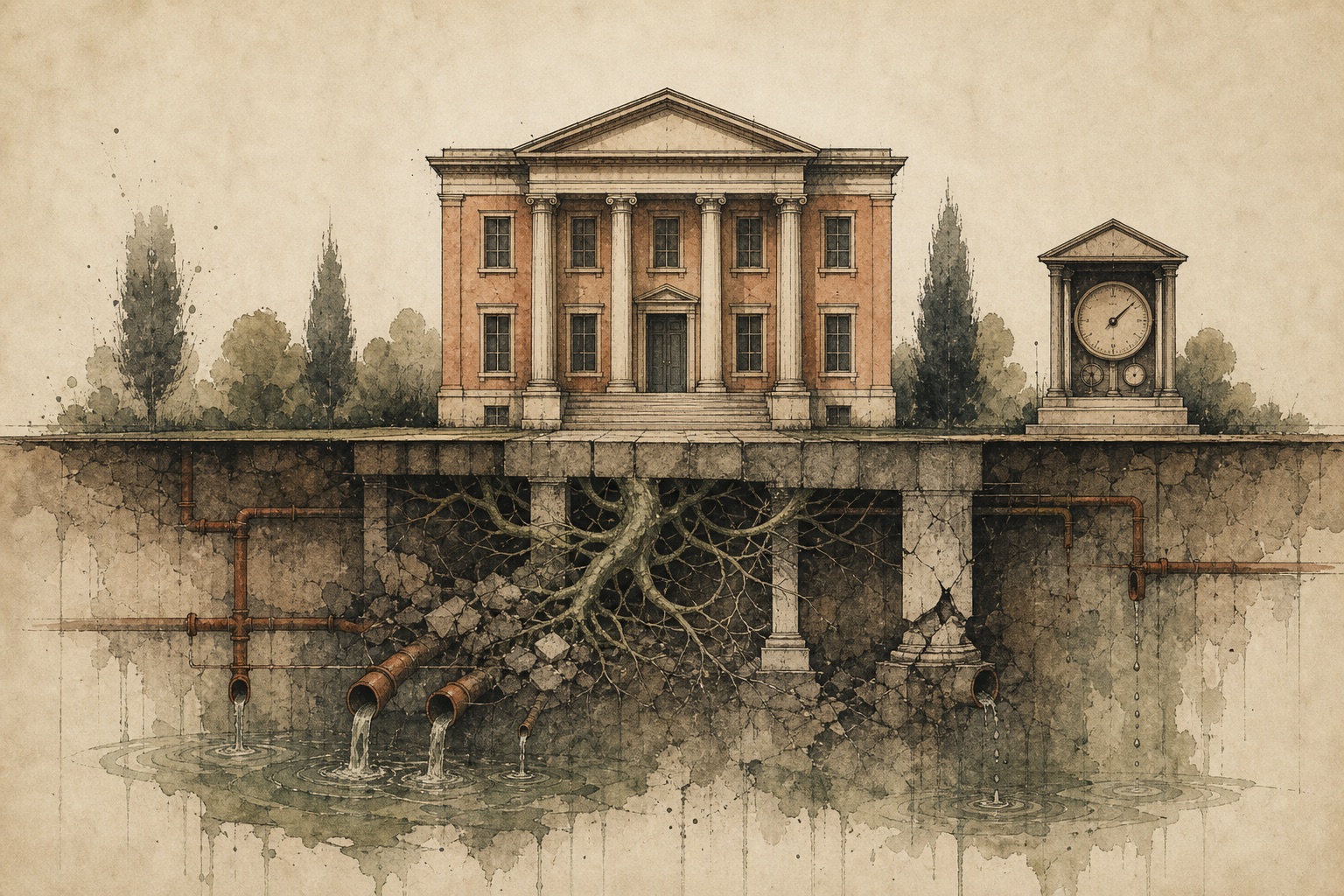
There is a simple way to catch this. Name the capacity you are actually trying to preserve, the living thing, not the symbol. Name the current form that claims to protect it. Then ask the question that ruins meetings and saves systems: Is maintaining this form now eating the capacity it exists to protect?
If the answer is yes, preserving the form is no longer continuity. It is predation. Letting that form change, shrink, hand off, pause, or end may be the more faithful act. The point was never to keep the shell intact. The point was to keep the living thing alive.
Continuity is not clinging. Sometimes the coherent move is to let a form you love come to a clean end so that what it carried can survive.
Diagnostic MethodThe coherence map
When something is stuck, the instinct is to ask, "Who is wrong?" Resist it, at least at first, and start with, "Where has alignment broken?"
Write five short lines:
The diagnosis lives in how the writing goes, because the same symptom can hide four completely different diseases.
Picture a once-great neighborhood restaurant going slowly quiet. Covers are down, regulars have drifted, reviews are softening, and nobody agrees why. Write the five lines and watch which one breaks.
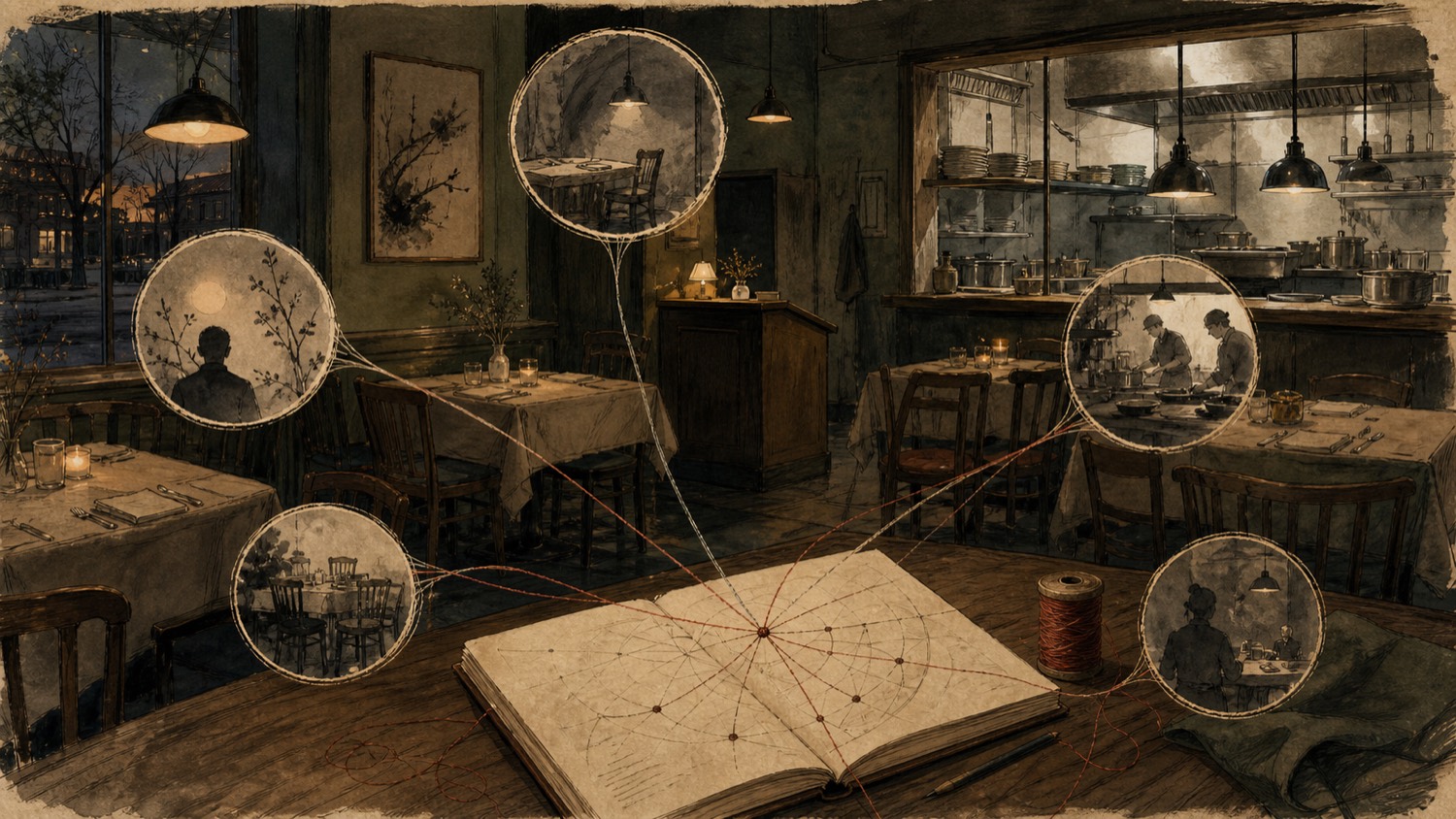
If the owner can no longer articulate what the place is even for, and cannot describe what is actually happening in the dining room, the system has lost track of itself. That is cognitive debt.
If the chef says service is killing them, the host says the chef got arrogant, and the owner says it's the economy, they only thought they shared a picture. That is social debt.
If everyone agrees the menu is stale, but the chef refuses to change a single dish because the menu is his, feedback has arrived but action is immovable because identity is sitting on its chest. That is political or emotional debt.
If the only signal the owner ever sees is the monthly P&L, meaning the regulars have been gone for two months before the numbers show the bleeding, that is structural debt.
Same empty room. Different break. Different cure.
Cognitive debt needs contact with reality. Social debt needs shared language and a direct comparison of models. Political debt needs incentives and safety changed so truth can move. Emotional debt needs the threatened identity named out loud before it silently vetoes every repair. Structural debt needs faster loops.
Blame fixes none of them. Diagnosis is the only thing that picks the right tool, and the same map reads a person as cleanly as an institution. If you are exhausted and stuck, the break might be that you can't say what you're trying to preserve, or that your model of your own life is five years out of date, or that you're still acting for an identity you no longer believe in, or that the people closest to you have stopped telling you the truth because you trained them not to. Same burnout. Different break. Different cure. That isn't softness. It's targeting.
Culminating PointWhen adding is killing you
When coherence fails, the universal instinct is to add. More meetings, more dashboards, more metrics, more transformation programs, more ceremonies in which adults put sticky notes on glass and hope the gods are appeased.
Sometimes adding is right. Far more often, adding is the thing killing you, because you are pouring more load onto a system already drowning in it, and calling the splashing progress.
The recovery feels like failure: halt, consolidate, shorten the lines, restore supply and reconnaissance, reduce load until you can see again.
Soldiers have a name for the place where this turns fatal: the culminating point. Every offensive reaches a moment past which its own strength no longer outruns its growing weakness. Supply lines stretch. Communications lag. Reserves thin. Reconnaissance falls behind. The force is still moving forward, but its ability to understand and sustain itself is coming apart.
A commander who keeps attacking past that point does not win harder. He loses by advancing: his lead elements outrun their own picture of the battlefield until a counterstroke folds them up.
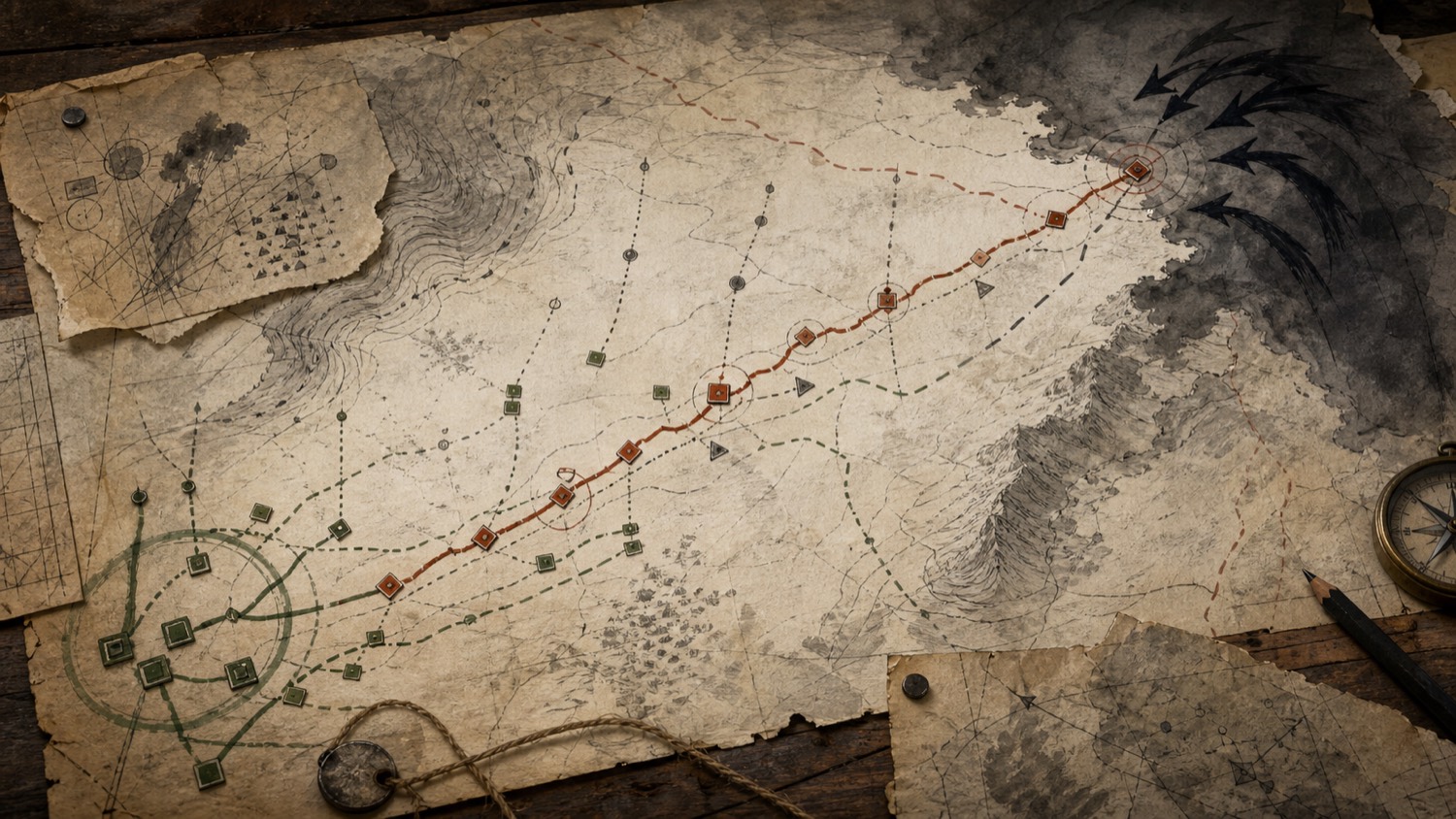
The recovery is one of the hardest orders in the profession to give, because it feels exactly like failure: Halt. Consolidate. Shorten the lines. Restore supply and reconnaissance. Reduce the load until you can see again. Only then resume.
That is the trap this whole essay keeps circling: confusing intensity with adaptation. Stopping feels like losing, so the instinct is to push, and sometimes pushing is the single move that guarantees the loss. The burned-out individual makes the identical mistake: a new productivity system, a stricter diet, a 5:00 AM routine, bolted onto a mind already past its culminating point.
The actual recovery is almost always subtractive. Thought returns after load falls, not before.
Repair DisciplineThe recovery discipline
When coherence is genuinely failing, the first move is not to get brilliant. It is to stop making the problem bigger.
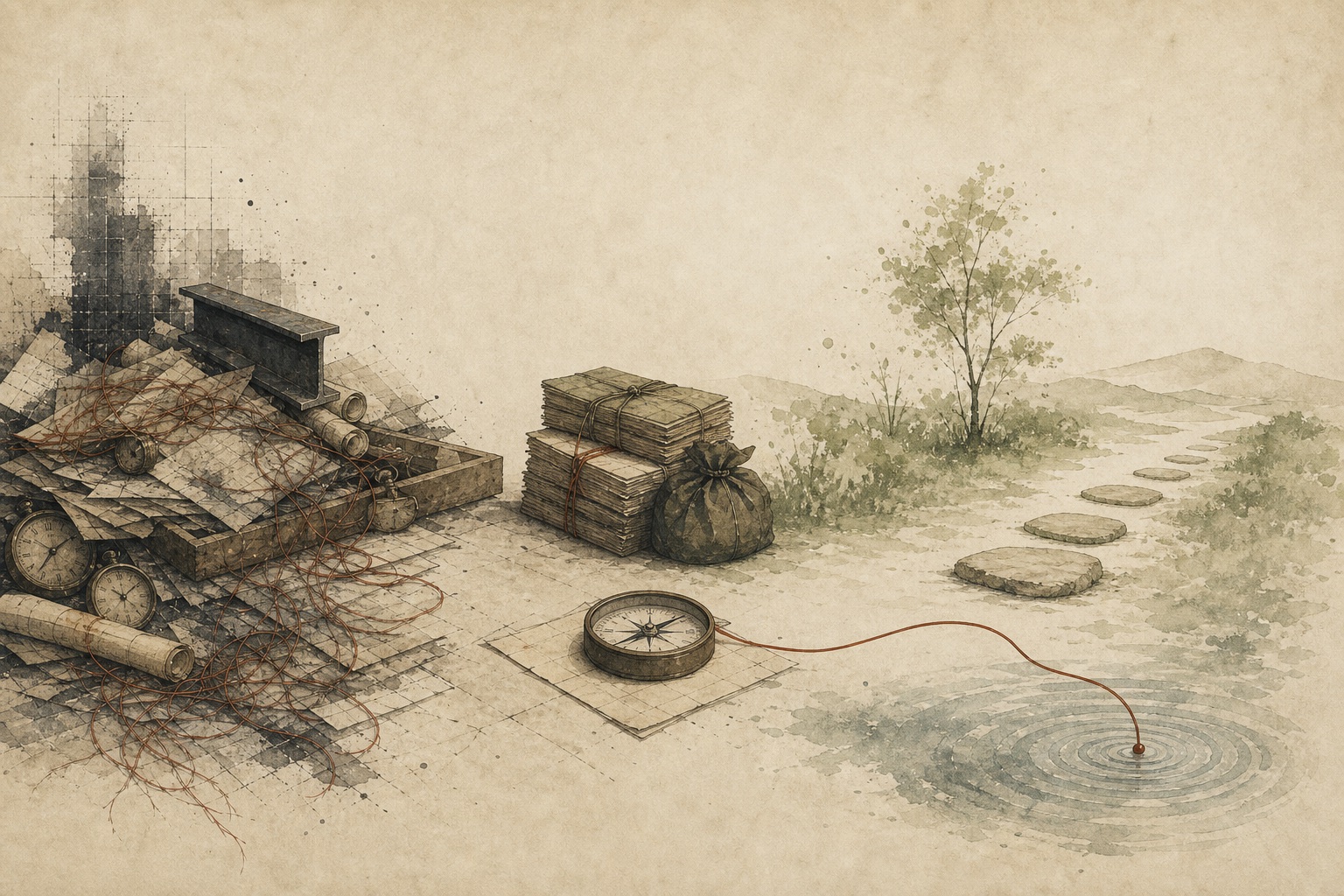
- Stop expanding scope. Freeze new commitments where you can.
- Name the capacity. Pick the real target: trust, cash, health, legitimacy, delivery, safety, or learning.
- Separate facts from interpretations. Known, inferred, feared, and wished cannot share one bucket.
- Find the nearest reality. Get the fastest honest feedback from the closest possible contact with the thing itself.
- Reduce load. Cut what can be cut.
- Shorten feedback loops. Raise the refresh rate and reduce translation.
- Protect source fidelity. Make truth cheaper to tell.
- Prefer reversible moves. Preserve your ability to learn before betting the farm.
- Install a feedback trigger. Decide in advance what observation would make you change course.
- Update memory. Write down the decision, the assumption, the owner, and the trigger.
Stop expanding scope. Freeze new commitments where you can. You cannot understand your load while you are still adding to it.
Name the capacity. Pick the real target: trust, cash, health, legitimacy, delivery, safety, learning. You cannot protect everything at once.
Separate facts from interpretations. Write down what is known, what is inferred, and what is merely feared or wished. In a crisis, plausible stories feel exactly like facts until you force the distinction onto paper.
Find the nearest reality. Get the fastest honest feedback from the closest possible contact with the thing itself. Not the summary of the summary. Not the morale-safe version. The thing.
Reduce load. Triage honestly. Cut what can be cut. Anything that does not serve the continuity target is, right now, a luxury you are paying for in coherence.
Shorten feedback loops. Raise the refresh rate. Look sooner. Look closer. Look with less translation between reality and the people deciding.
Protect source fidelity. Make truth cheaper to tell. Open protected channels for bad news, and reward the first accurate negative report more openly than good news. If people are punished for reporting reality, the system is blind by design.
Prefer reversible moves under uncertainty. When you don't know enough, choose steps you can walk back. Preserve your ability to learn before betting the farm on a confident slide deck.
Install a feedback trigger. Decide in advance what observation would make you change course, while you can still think clearly, before fear and pride start lawyering the evidence.
Update memory. Write down what changed and why: the decision, the assumption, the owner, the trigger. Otherwise, the system pays the same tuition twice.
Use this discipline to diagnose and act, once, and then put it down. Do not institutionalize it as a standing committee or a quarterly coherence review. A framework that metastasizes into more process has become the exact disease it was built to find. The goal is restored contact with reality, not a fresh ritual.
First ChoiceThe choice underneath
Everything so far has treated continuity, staying able to adapt, as the thing worth preserving. That deserves honesty, because it isn't a proof. It's a choice: the decision to value the ongoing capacity to learn, repair, respond, and remain able to choose over any single perfect outcome, pure identity, or blaze of glory.
Nobody can prove you should always value that. There is no law of physics that ranks continued existence above a glorious end, and history is full of people who looked at the trade clear-eyed and chose the end.
At Thermopylae, Leonidas and the Spartans who stayed with him did not misunderstand the odds. They knew that staying meant dying, and they stayed anyway, to buy time and to make a stand whose meaning outlived every man who held the line. By this framework's own test, that is not incoherence. It is a clear-eyed choice serving a different value underneath: honor, sacrifice, defiance, the worth of a stand. This framework has nothing to correct in that. It can only say, plainly, that Thermopylae was never a continuity play.
This essay is for the other times. The times where you have decided you want to come through intact and still able to move.
So why choose continuity when you do? Because it keeps the options alive. After losing New York in 1776, George Washington mostly stopped trying to win pitched battles. He had worked out that the British could beat a great many things, but they could not beat a Continental Army that simply continued to exist. He stopped offering the decisive battle his pride demanded, and concentrated on not losing the army.
It was the same logic Fabius used against Hannibal: refuse the glorious pitched fight, absorb the mockery, preserve the force, deny the enemy the victory he needs. As long as the army existed, the cause existed. A destroyed army ends the revolution in an afternoon; a surviving one keeps every future open.
Continuity is not avoiding risk. It is refusing to spend the capacity that makes future action possible merely to satisfy the emotional demand for a dramatic form. It is the recognition that a system still in motion can still learn, still change its mind, still repair what it broke, and still become less wrong tomorrow.
Continuity is not the highest value. It is the value that keeps the other values available over time. And even that is a choice.
No Prestige BorrowingBorrow humility before prestige
There is a temptation to dress all of this up as hard science, and the temptation is real, because the analogies are everywhere: entropy, signal and noise, control theory, cybernetics.
Some of them are genuinely illuminating. But there is a cheap version of the move, and it should be shot on sight.
You have met the executive who justifies the annual reorganization by invoking the second law of thermodynamics: All systems tend toward disorder, therefore we must continually reorganize.
The physics is doing precisely no work in that sentence. It's a costume. Strip it off, and the real claim is ordinary and arguable: I think we should reorganize. Fine. Say that, and defend it, instead of wrapping it in a law of the universe so that no one can disagree without sounding anti-science. The tell is always the same: you could swap the law for its exact opposite and the memo would read just as confidently.
Borrowing the prestige of physics or information theory to make a point about teams or lives feel inevitable is borrowing authority you haven't paid for.
The honest version is humbler and stronger: Reality is simply more expensive to keep track of than our slogans, dashboards, identities, and certainties want to admit, and systems fail when the world changes faster than they can perceive, remember, interpret, decide, and respond.
You don't need an equation to see that. You've watched it happen. When you borrow from the sciences, borrow their humility before their prestige.
Right and WrongWhat this can and can't tell you about right and wrong
This framework has exactly one thing to say about strategy, and it is an observation about consequences, not a moral proof.
Strategies that protect feedback, trust, learning, and repair tend to stay more adaptive over time. Strategies that win by destroying those conditions, through deception, coercion, permanent secrecy, or the punishment of truth, tend to pile up hidden debt. People stop reporting reality, the system loses the ability to catch its own errors, and it becomes dependent on control instead of perception. Control works until conditions change. Perception is the thing it traded away.
But be careful here, because coercive systems can last a long time, and that longevity is exactly what makes them tempting. A tyranny can be intensely coherent toward its aim while going steadily blind to reality, because the very tools that force the alignment are the tools that sever the feedback. Suppress dissent and you also suppress the early warning.
The system buys a high instrumental coherence at the cost of its contact with the world, which is why it can look unbreakable for years and then fail strangely fast: the blindness was accumulating invisibly, until reality arrived all at once and there was no longer any channel through which to see it coming.
If a strategy only works as long as the people affected by it cannot understand it, it is borrowing from the future.
A Ponzi scheme is the pure case; it runs only while the investors don't grasp the mechanism, and dies the afternoon they figure it out. The everyday version is smaller and just as diagnostic: the manager who keeps two reports from ever comparing notes because each has been promised a different thing. It runs smoothly right up until they talk in a hallway.

This is not a rule against all secrecy. A surgeon may pace how fast she delivers a hard diagnosis. A negotiator may hold a reservation price. A commander may keep the timing of an operation from the enemy. You don't announce the surprise party in advance.
But none of those require the affected person to stay misled forever. The deal, once struck, survives both sides fully understanding it afterward. The surprise party resolves when everyone jumps out and terrifies Aunt Linda.
Bounded secrecy is timing. Parasitic secrecy is a loan against someone else's ignorance, and that loan always comes due.
FalsificationWhat would make this the wrong tool
A way of seeing that can never be wrong is not a tool. It is a faith. So it is worth saying plainly what would make this framework fail.
If systems that hide their debt, lie to themselves, punish their messengers, and corrupt their own feedback reliably outlasted and out-adapted the systems that stayed in honest contact with reality, not in one lucky season, but across hard shocks and long time horizons, then this whole picture would be backwards, and you should drop it.
If carrying load you cannot track turned out to cost nothing, the central idea would be empty. And if reducing load, refreshing the model, restoring feedback, and clarifying the aim did nothing for a stuck system's ability to act, then coherence debt probably wasn't the main failure.
And often it won't be. Sometimes the design is bad. Sometimes the resources are simply insufficient. Sometimes the market is gone, the enemy is better, the leader is lying, or the thing you're straining to preserve should not be preserved.
The coherence lens does not replace those explanations. It asks the prior question underneath all of them: Does the system still have enough honest contact with itself and reality to know what kind of failure it's facing?
If the answer is yes, use another tool. If the answer is no, start here.
Pocket VersionThe pocket version
When things are coming apart, ask five questions:
- What capacity are we actually trying to preserve?
- What current form is claiming to preserve it?
- What load are we carrying that we can no longer keep current?
- What feedback is missing, stale, filtered, or dangerous to report?
- What can we stop doing until we can see again?
Those five won't fix everything. But they will usually tell you where the blood is coming from, which beats another dashboard measuring the angle of the corpse.
If you remember nothing else:
Coherence is not tidiness. It is the working alignment among aim, model, memory, action, and feedback.
Continuity is not clinging. It is the choice to keep the capacity to adapt alive, even when that means letting a beloved form change or end.
Load is not just busyness. It is the whole burden of what a system must know, coordinate, remember, interpret, risk, and emotionally tolerate in order to keep acting intelligently. Coherence debt is what appears when that burden outruns the system's ability to keep its picture of reality current and trustworthy.
When the pressure rises, the instinct is to add. Often the cure is subtraction. Do less, on purpose, until you can see again.
The whole framework earns its keep in exactly one way: if it helps a real, living system notice where it is losing contact with reality, set down the load it cannot carry, and take the next step, without wrecking its ability to learn from the one after that.
AI-Augmented Work Disclosure
Many artifacts on this page were developed using my AI-assisted Crucible workflow.
I use AI as a force multiplier: a drafting partner, critic, adversarial reviewer, synthesis engine, and editor. The process helps me expand initial ideas, find hidden connections, test assumptions, refine structure, and sharpen the final product.
This is not something I hide or apologize for. I consider effective AI collaboration an emerging professional skill.
The work remains mine because the judgment remains mine. I originate the direction, select what survives, revise the output, verify claims where needed, and take responsibility for the final artifact, including its reasoning, accuracy, citations, conclusions, and errors.
AI helped forge the artifact. I own the blade.