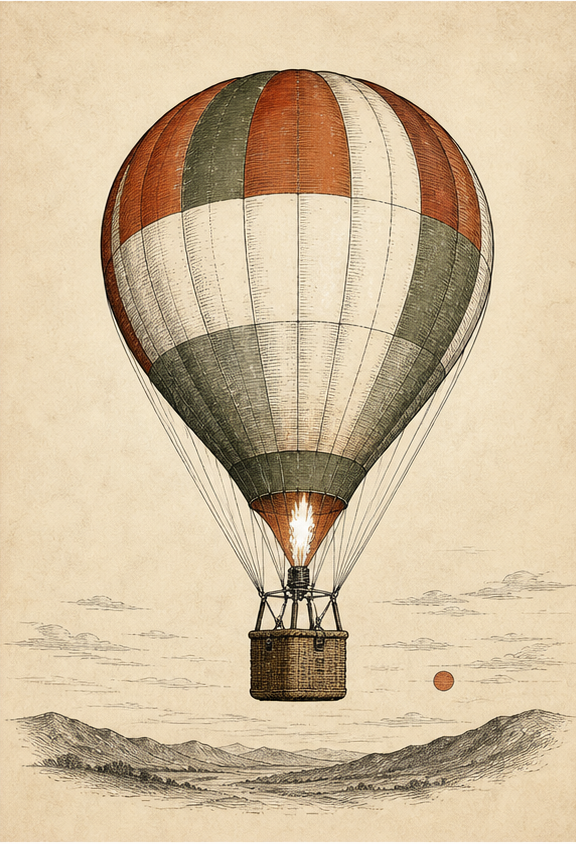
I posted something on X recently about Mo Gawdat's framing of AI as the next leverage layer in human history. Hunter-gatherer to agriculture to industry to information to AI, with each transition rewarding whoever owned the automation beneath everyone else. I said the framing was good, that staying at the bleeding edge will require cybernetic merger most people won't want, and that for the rest of us, life will probably get more prosperous and interesting the way each previous epoch jump made it.
That last part wasn't quite right. Or rather, it was right in a way that almost everyone, including me in 280 characters, gets wrong. Let me try to do this properly.
Movement IThe Optimism Trap
The standard takes on AI sort into a few familiar buckets. Things will get better (Pinker, Kurzweil, the accelerationists). Things will get worse (the doomers, the displacement-anxious). Things will be mixed but we'll adapt (the Mo Gawdats of the world, lamenting the narrowing of the elite path while waving at general prosperity).
All of these takes share a hidden assumption: that the measurement frame stays constant across the transition. They argue about whether the numbers go up or down, but the numbers themselves, material wealth, productivity, lifespan, professional status, and cognitive capability, are inherited from the epoch that's ending. They're the metrics the Enlightenment told us to care about. They're System 2 metrics. They're the metrics the entire knowledge economy was built to optimize.
If you measure the AI epoch with those instruments, you get a story about disruption and adaptation, with the elite path narrowing and the masses experiencing some mix of gains and losses. That's Mo's story. It's not wrong on its own terms. It's just stuck inside a frame that's about to break.
Movement IIThe Civic at the Drag Strip
For the last two hundred years, civilization has been a drag strip built for Honda Civics.
The Enlightenment, the Industrial Revolution, and the Information Age: these eras selected for and rewarded a particular kind of human cognition. Analytical reasoning. Symbolic manipulation. The ability to hold complex abstractions in working memory and run logical operations on them. Call it System 2 thinking, after Kahneman. Call it Spock cognition, if you grew up on Star Trek. Whatever you call it, this is what universities credentialed, what professions selected for, what the knowledge economy paid premiums for.
And it worked. System 2 cognition built the modern world. Science, engineering, law, medicine, finance, technology: all of it runs on the kind of explicit reasoning that the Civic-class human is good at. The whole institutional apparatus of credentialing, hierarchy, and reward got optimized to identify these humans and put them in positions of leverage.
The Civic was never the race car.
It was the only vehicle
available.
The Honda Civic
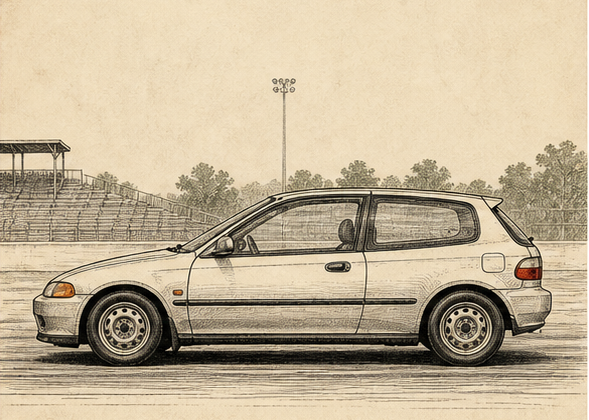
Universities credentialed it. The knowledge economy paid premiums for it. It built the modern world. Pressed into drag duty because nothing better existed, and now the staging lane has changed.
The Top Fuel Dragster
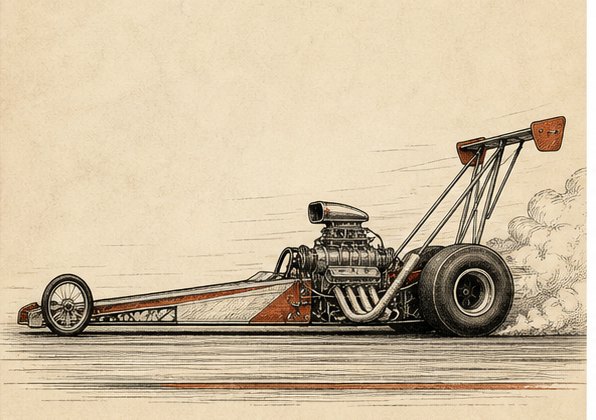
Pure analytical altitude. Unlimited fuel. No fatigue. The Civics don't suddenly become useless; their value at the drag strip simply collapses to zero, because the drag strip is no longer where the value is.
It's worth being precise about which System 2 collapses and which amplifies. Generic analytical work (drafting, summarizing, writing boilerplate, mid-tier code, standard analysis, routine research) gets compressed toward zero marginal cost. That's the Civic's old job, and the dragster does it for free. Architectural System 2 work (designing the constraint structures, the multi-agent workflows, the just-in-time context loading, the evaluation harnesses, the systems that direct what the dragster does and verify the output) becomes more leverage-bearing, not less. The shallow layer commoditizes. The deep layer amplifies.
A note on durability. Architectural System 2 work is currently a high-leverage human capability. It probably won't stay that way. AI systems are already learning to design and orchestrate other AI systems, and that capacity will compress the architectural craft layer the same way the previous compression hit generic execution. What stays durable is the stakes-loop work at the boundaries of the system: targeting (what's worth building, in this moment, for what bounded meaning) and discrimination (whether the system is doing the actual work or simulating its form). The architectural craft is the connective tissue between those two. Today's Orchestrator does targeting plus craft plus discrimination. Tomorrow's increasingly does targeting plus discrimination, with the craft layer handled by AI systems. The durable role is smaller and more concentrated than today's, but it's the role that doesn't compress, because it runs on lived stakes that AI doesn't have.
What ends is the assumption that analytical altitude is the point. That assumption has organized two centuries of credentialing, hierarchy, and reward. Its ending opens ground that was always more interesting than the strip we built on top of it.
Movement IIIWhat System 2 Was Actually For
Here's the move most people haven't made yet. System 2 cognition was never the goal. It was the balloon.
You build a hot air balloon to ascend. You ascend in order to see. The view is the point. Nobody confuses the balloon for the view. Nobody chrome-plates the gondola and calls it a destination. The balloon is disposable infrastructure for accessing perspective you can't get from the ground.
For two centuries, civilization mistook the balloon for the destination. We optimized the gondola, credentialed the pilots, built entire institutions around the production of balloon-flight capability. We forgot the ascent was supposed to enable something. We started treating altitude as the point.
AI commoditizes the balloon. Anyone can ascend now. Analytical altitude is trivially available. The skill of getting up there, which used to be what the educated class was selected for, becomes worthless almost overnight, at least in its generic form.
What survives is what you do with the view. Whether you can see. Whether you can hold what you see and bring it back down and commit to it and build with it. That's not balloon work. That's what the balloon was always for.
Movement IVThe Activities That Actually Matter
If you ask what gives a human life meaning, you get answers like culture, exploration, sense-making. Activities that connect us to something larger, that engage our capacity for wonder, that let us participate in the ongoing project of figuring out what it means to be here.
The Modernist measurement frame translated these into System 2 terms. Culture became cultural production: books written, films made, papers published. Exploration became discovery of new facts, new territories, new technologies. Sense-making became the construction of complete metaphysical systems, theological or scientific. But these are translations. They were never the things themselves.
Real culture is the lived experience of belonging to a tradition, committing to local meaning, participating in rituals and practices that give shape to a life. A person embedded in a demanding local ritual culture may experience more actual cultural belonging than a modern consumer with unlimited content access, even when the embedded life is harder, less free, and more constrained in every other way. The Marines I served with had thicker shared culture than most civilians experience in their adult lives, not because military life was better, but because it was bound. Culture is commitment, not content.
Real exploration is the embodied act of attending to what's actually there. The first time you really see a sunset. The moment a piece of music opens something in you. The face of someone you love. AI can map the protein folding space faster than humans. It cannot have an experience. The exploration that survives the AI epoch is the exploration of qualia, the territory Rick Rubin and David Lynch have always been working.
This is where the easy reading of the argument fails, and the distinction matters. AI can already generate the artifacts of System 1 reception: Rubin-shaped music production, Lynch-shaped film aesthetics, wabi-sabi-shaped poetry, Rothko-shaped color fields, the painted sunset. From the artifact-production side, "retreat to System 1" is not a safe harbor. The machine produces receiver-shaped outputs faster than any human.
The human edge isn't that human-made artifacts carry some mystical residue of suffering that the receiver's nervous system magically detects. The waveforms don't come with metadata tags proving someone bled to make them. The edge is upstream and downstream of the artifact itself.
Upstream: knowing which state needs to be installed in this specific moment, in this specific cultural or strategic context, for this specific purpose. The machine can generate any payload on demand. It cannot decide that this payload is what this moment in the world actually requires. That's a targeting capacity, and it runs on lived stakes: the human's accumulated history of mattering about specific things in specific ways.
Downstream: distinguishing whether an artifact is doing the work or merely simulating the form of doing the work, and iterating across years based on what didn't quite land. The wabi-sabi poem may install a state, but the human steeped in the tradition can tell whether the poem is true to the tradition or surface-mimetic. AI can iterate on metrics. It cannot iterate on what it cared about, because it didn't care.
AI can paint the sunset. AI cannot care whether the sunset gets painted, cannot tell whether this painted sunset matters in this moment, and cannot refine its sunset-painting practice across decades based on what mattered and what didn't. That's the human edge. Not magic in the artifact. Stakes in the loop.
What changes in the AI epoch isn't that System 2 becomes worthless. It's that System 2 stops being the prestige center and becomes support infrastructure for taste, judgment, commitment, and embodied meaning. The balloon stays in the budget. It just stops being mistaken for the destination.
Movement VThe Rubin · Lynch · Marcus Lineage
This isn't a new mode. It's the older arrangement, briefly forgotten. Three figures across two thousand years show the pattern.
Receptive capacity as foundation,
analytical capacity as servant.
Doesn't write the songs. Doesn't play at the level of his clients. He sits with the work and notices what is alive in it. Decades of pattern recognition operating below the level of articulation, backed by ruthless editorial structure.
“More of that.”
–
without explaining why.
You don't generate the deep ideas. You quiet down enough to notice them. Transcendental meditation isn't an aesthetic affectation; it is professional infrastructure. The receiver is the instrument. Then come scripts, edits, financing, the brutal mechanics of making the film.
“Ideas are like fish.
The bigger fish are deeper down.”
The Meditations are not philosophy. They are the same insights restated hundreds of times, in slightly different forms, across years. Repetition is how System 1 wisdom installs. While running an empire, while managing campaigns, one stack, not two.
“The signal traveled two thousand years because the sincerity was unperformed.”
The pattern is consistent across cultures and centuries. The activities that make human life meaningful begin below explicit reasoning, then require discipline, repetition, and form. The Modernist project of running them through System 2 frameworks alone was a productive detour that's now ending. What replaces it isn't pure System 1. It's the older arrangement.
Movement VIThe Meta-Modern Operator
There's a name for the cognitive stance that fits the epoch we're entering. Meta-modernism. The technical philosophical position is well-mapped in academic papers and a few Substacks, but it hasn't propagated as lived operating manual yet. Let me give you the operational version.
From the dream of total closure
to the discipline of bounded
commitment.
Meta-modernism is the third move. It says: the metaphysical systems don't close, and we're going to play beautifully anyway. Build local truths, bounded truths, contingent and chosen rather than universal and proven, regardless of whether they operate at the scale of a tea ceremony or an empire. Commit to meanings you know are local in that sense. Use System 2 sophistication in service of System 1 commitment rather than as a permanent escape from it. Ascend the balloon, get the view, come back down, and build with what you saw.
The Meta-Modern Algorithm
Gather until the noise floor
Collect data until you hit diminishing returns or the time wall, whichever comes first. The point is not completeness. The point is sufficiency.
Admit the absence of God's eye
You don't have the view from nowhere. You never will. The honest practice is to stop pretending you do, and to stop letting that be a reason to refuse to act.
Insert an axiom of faith
A value commitment, a chosen meaning: bounded, local, owned. Not proven. Chosen. Marcus would have called it serving Rome anyway.
Move with conviction
Act as if you had certainty. The conviction is real even when the metaphysics is bounded. Hesitation contaminates the signal.
Update with humility, not ego
When reality hits back, change the commitment. The discipline is not certainty; it is correction without collapse.
This isn't optimism. It isn't pessimism. It's a third stance most public discourse hasn't built the slot for yet. Which is part of why takes that operate from this stance read as confused or contradictory to readers running Modernist or post-modernist operating systems. The compression doesn't survive the transmission.
Movement VIIThe Real Bet on AI
So here's the take I should have written instead of the gloss I posted.
The AI epoch isn't going to make life better in Pinker terms or worse in doomer terms. It's going to change what counts as the relevant question.
The cybernetic-merger path Mo describes, staying at the bleeding edge by augmenting yourself with AI capability, is powerful but spiritually incomplete. It can increase altitude. It cannot tell you where to land. People trying to ride that path become faster Civics, optimizing for the cognition that just got commoditized. Most people will correctly intuit that this path isn't satisfying, but the deeper reason isn't lifestyle preference. It's that the path itself is running on the wrong axis.
The actual bet is the meta-modern bet. Use AI to commoditize the balloon. Let analytical altitude become trivial. Then descend, and do the work that altitude was always supposed to enable.
The Orchestrator.
Not the System 2 operator trying to out-compute the machine; that path is closed. Not the System 1 receiver passively consuming machine-generated experiences; that path is consumption, not creation. The Orchestrator is the third position.
The human owns the why and the frame. The machine handles the volume. The deep architectural work in the middle is where the actual leverage lives, the part most likely to be missed by both the accelerationists who think AI handles everything and the doomers who think humans handle nothing.
Build artifacts that transmit rather than explain. Stand in front of a Rothko long enough to feel what it's doing, that's the model. The painting doesn't argue for anything. It installs a state. Good art bypasses the System 2 channel and delivers qualia directly. The civilizational work of the meta-modern epoch is building more of these, games, rituals, communities, practices, spaces, that install operating principles experientially rather than through prose argument alone.
Commit to local meaning while knowing it's local. Marcus knew Rome was mortal. He served it anyway. He wrote the Meditations without knowing anyone would ever read them. The signal traveled across two thousand years because the sincerity was unperformed. That's the Marcus move and it scales: do the work as if no one is watching, including any future AI that might read your corpus, because performance for an imagined audience degrades the signal.
Become a better receiver. The signal antenna, the sensitivity to aesthetic and emotional and ethical resonance that the System 2 economy systematically attenuated, is the actual instrument of the next epoch. Most of us have spent decades dulling it through institutional and goal-oriented operation. Sharpening it is the new skill. And then directing the analytical capacity that AI now makes cheap toward whatever the receiver tells you actually matters.
Trust the descent. The view from altitude is real, but it doesn't give the view its weight. The weight comes from coming back down and committing to specific bounded realities under acknowledged humility about what we can know. The Operators, the artists, the meta-modern early adopters who learn to descend will quietly build the infrastructure for what comes after, in the gaps the institutional collapse opens up.